
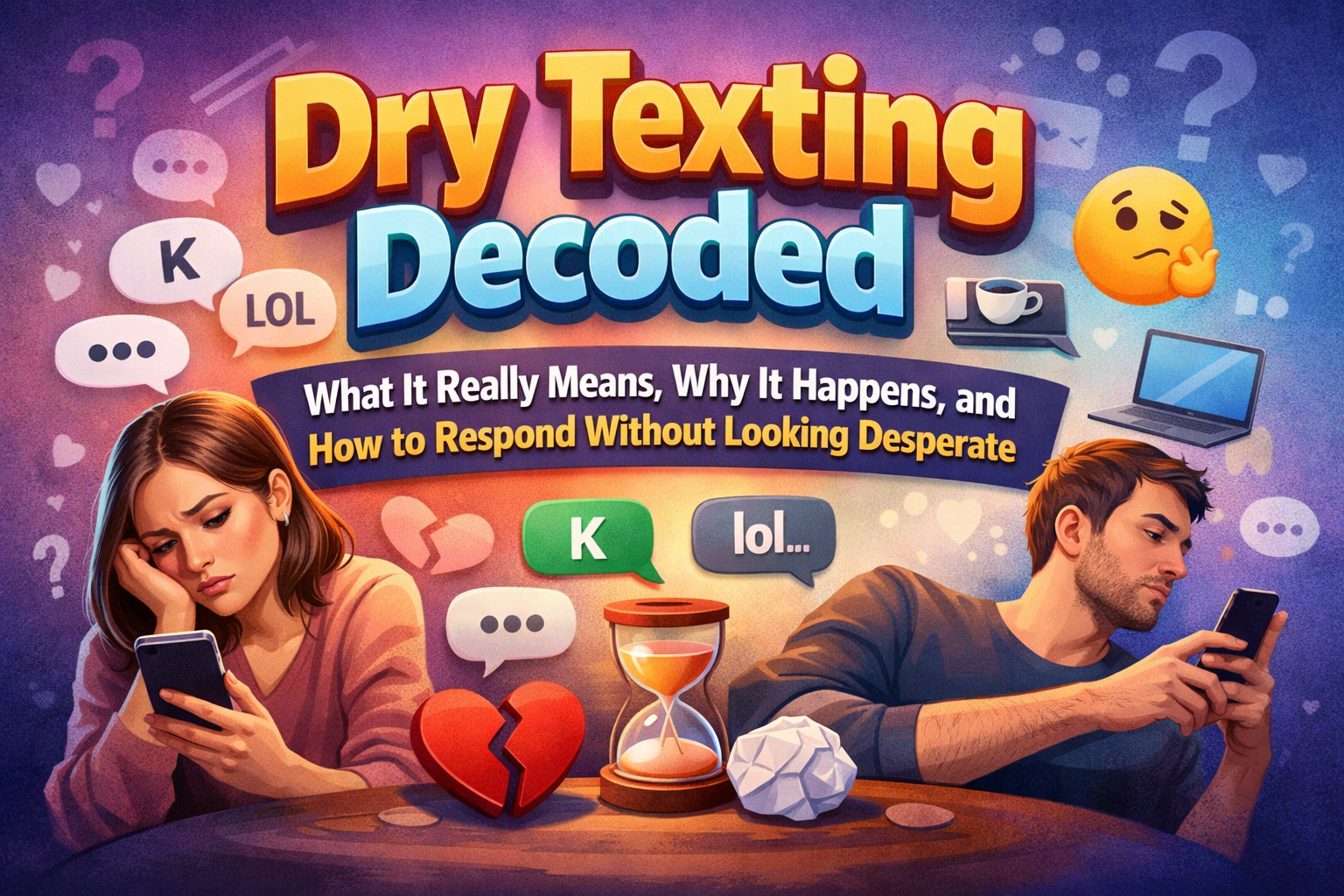
Introduction: When Conversations Feel Like Pulling Teeth
You know the feeling. You send a thoughtful message, maybe even something funny… and the reply you get is:
“lol”
“k”
“yeah”
That’s it.
No follow-up. No energy. No effort.
It’s like trying to have a conversation with someone who’s half-asleep—or worse, half-interested. Welcome to the world of dry texting, where enthusiasm goes to die and overthinking begins.
But here’s the truth most people miss: dry texting isn’t just annoying—it’s information. If you know how to read it correctly, it can save you time, energy, and emotional stress.
Let’s break it all down.
What Dry Texting Actually Is (And Why It Feels So Off)
Dry texting is when someone responds in a way that keeps the conversation alive—but barely.
We’re talking about:
- One-word replies
- Generic reactions with no follow-up
- Responses that don’t build momentum
Examples include:
- “k”
- “lol”
- “yeah”
- “fine”
- “haha” (with no continuation)
On the surface, these messages aren’t rude. But communication isn’t just about words—it’s about effort. And dry texting signals low effort.
That’s why it feels frustrating. You’re putting in energy, and they’re giving you the conversational equivalent of a shrug.
Why Dry Texting Happens: The Real Reasons Behind It
Before jumping to conclusions, it’s important to understand that not all dry texting comes from the same place.
1. Low Interest (The Hard Truth)
Sometimes, the simplest explanation is the correct one: they’re just not that into the conversation—or into you.
Instead of ghosting completely, they keep replying just enough to avoid seeming rude. It’s a soft exit strategy.
2. They’re Just Not Good at Texting
Believe it or not, some people are genuinely terrible at texting.
In person, they might be funny, engaging, and expressive. But on a screen? Flat. Minimal. Dry.
For them, texting is functional—not emotional.
3. They’re Distracted or Busy
Life happens.
Work, family, responsibilities, or even just mental fatigue can lead to low-effort replies. Not every dry message is a sign of disinterest—sometimes it’s just bad timing.
4. They’re Matching (or Testing) Your Energy
Some people subconsciously mirror the effort they receive.
Others intentionally hold back to see if you’ll carry the conversation. It creates a dynamic where one person invests and the other observes.
Not the healthiest approach—but it’s common.
What Dry Texting Means (And What It Definitely Doesn’t)
Here’s where people tend to overthink.
What It Can Mean:
- They’re not emotionally invested in the conversation
- They’re unsure about you
- They prefer real-life interaction over texting
- They’re distracted or uninterested in the moment
What It Doesn’t Automatically Mean:
- They hate you
- They’re playing games (not always)
- You did something wrong
- The connection is completely dead
The key question isn’t “What does this one message mean?”
It’s: “Is this a consistent pattern?”
Patterns tell the truth. One message doesn’t.
How to Respond to Dry Texting Without Losing Your Dignity
Most people make one of two mistakes:
- They try harder (writing longer messages)
- They overreact and pull away emotionally
The smarter approach is balanced.
1. Mirror Their Energy (Once)
If they’re giving one-word replies, don’t send paragraphs.
Match their effort briefly and observe what happens. If they step up—great. If not, you’ve learned something valuable.
2. Shift the Conversation Off Text
Some people simply aren’t built for texting.
Instead of forcing it, say something like:
- “Let’s continue this over coffee instead.”
- “You seem more like a real-life conversation person.”
This separates genuine interest from passive chatting.
3. Call It Out—But Keep It Playful
A little humor can reset the tone.
Examples:
- “Wow, you’re really making me work for these replies.”
- “This conversation feels like Morse code.”
If they care, they’ll adjust. If they don’t, they’ll stay dry—and that’s your answer.
4. Stop Over-Investing
Don’t reward low effort with high effort.
If someone isn’t engaging, pulling back slightly is not a game—it’s self-respect.
5. Know When to Walk Away
If:
- They never initiate
- They never build the conversation
- They avoid meeting in person
Then you’re not in a conversation—you’re in a loop.
And loops don’t go anywhere.
10 Clever Comebacks That Call Out Dry Texting (Without Being Rude)
Sometimes humor is the best way to handle low-effort replies.
- “Wow, don’t overwhelm me with all those words.”
- “Such deep conversation. I’m learning so much.”
- “Careful, you’ll strain your thumbs typing that much.”
- “Blink twice if you need help.”
- “This feels like texting in silent mode.”
- “Minimalist texting… I respect the art.”
- “You’re really keeping me on my toes here.”
- “I see you’re a person of very few words.”
- “Should I bring subtitles into this conversation?”
- “At this rate, we’ll finish this chat next year.”
Use these lightly. The goal is to invite engagement—not create tension.
10 Flirty Ways to Turn a Dry Conversation Into a Fun One
If you want to revive the vibe instead of roasting them, try this approach:
- “You’re kind of mysterious… I can’t tell if I like it or not.”
- “I feel like there’s more to you than these short replies.”
- “You’re making me curious now.”
- “I might need the full version of you in person.”
- “Are you always this quiet, or am I special?”
- “I feel like you’re holding back on me.”
- “Short texts, big mystery.”
- “You’re definitely not giving everything away.”
- “I’ll let you off the hook—for now.”
- “I think you owe me a better reply next time.”
This approach works when there’s some interest—just not enough momentum.
How to Tell If They’re Interested or Just Wasting Your Time
This is the question that matters most.
Signs They Like You (Even If They Text Poorly)
- They make real plans
- They show up consistently
- They’re engaged in person
- They initiate sometimes
Signs They’re Not That Interested
- You always start the conversation
- Replies are always short, never evolving
- Plans are avoided or vague
- There’s no real curiosity about you
The Rule You Should Never Ignore
If someone genuinely likes you, you won’t feel confused all the time.
Confusion is often a sign of inconsistency—and inconsistency usually means low investment.
The Psychology Behind Dry Texting (Why It Triggers You So Much)
Dry texting hits deeper than it should—and there’s a reason.
Humans are wired for reciprocity. When you give effort, you expect effort back.
When that balance is off, your brain interprets it as rejection.
Even if logically you know they might just be busy, emotionally it feels like:
- Disinterest
- Dismissal
- Lack of value
That’s why dry texting creates anxiety—it disrupts emotional rhythm.
NEW: How to Fix a Dry Conversation Before It Dies Completely
Most people either push harder or give up too quickly.
Here’s a smarter middle ground.
Ask Better Questions
Avoid yes/no questions. Instead of:
- “Did you have a good day?”
Try:
- “What was the most interesting thing that happened today?”
Introduce Emotion or Playfulness
Flat conversations stay flat unless someone changes the tone.
Add:
- Humor
- Teasing
- Curiosity
Change the Medium
If texting isn’t working:
- Suggest a call
- Send a voice note
- Move to real-life interaction
Sometimes the problem isn’t the person—it’s the platform.
NEW: The Biggest Mistakes People Make With Dry Texters
If you want to stand out, avoid these common traps:
Over-Texting
Sending multiple messages to “revive” the conversation often makes things worse.
Seeking Validation
Asking “Are you okay?” or “Did I do something wrong?” too early can lower your value in the interaction.
Forcing Chemistry
If the vibe isn’t there, no amount of clever texting will create it.
Ignoring Clear Patterns
Hope can blind you to reality. If it’s consistently dry, believe the pattern—not your expectations.
Final Thoughts: Go Where the Energy Is
Dry texting isn’t something you need to decode endlessly.
It’s a signal.
Either:
- They’re not that interested
- They’re not a texter
- Or the connection just isn’t strong enough
And that’s okay.
The goal isn’t to force conversations—it’s to find people where communication flows naturally.
Because the right connection doesn’t feel like work.
It feels easy.
Frequently Asked Questions About Dry Texting
What does dry texting mean in dating?
It usually means low-effort communication, which can signal disinterest, distraction, or a mismatch in communication style.
Is dry texting always a red flag?
Not always. If they show effort elsewhere (like making plans), it’s likely just a texting habit.
Should you keep texting someone who replies dry?
Only if they show genuine interest outside of texting. If not, it’s better to move on.
Can someone like you and still text dry?
Yes. Some people are simply better in person than over text.
What’s the best way to respond?
Match their energy, keep things light, and avoid over-investing too quickly.
