
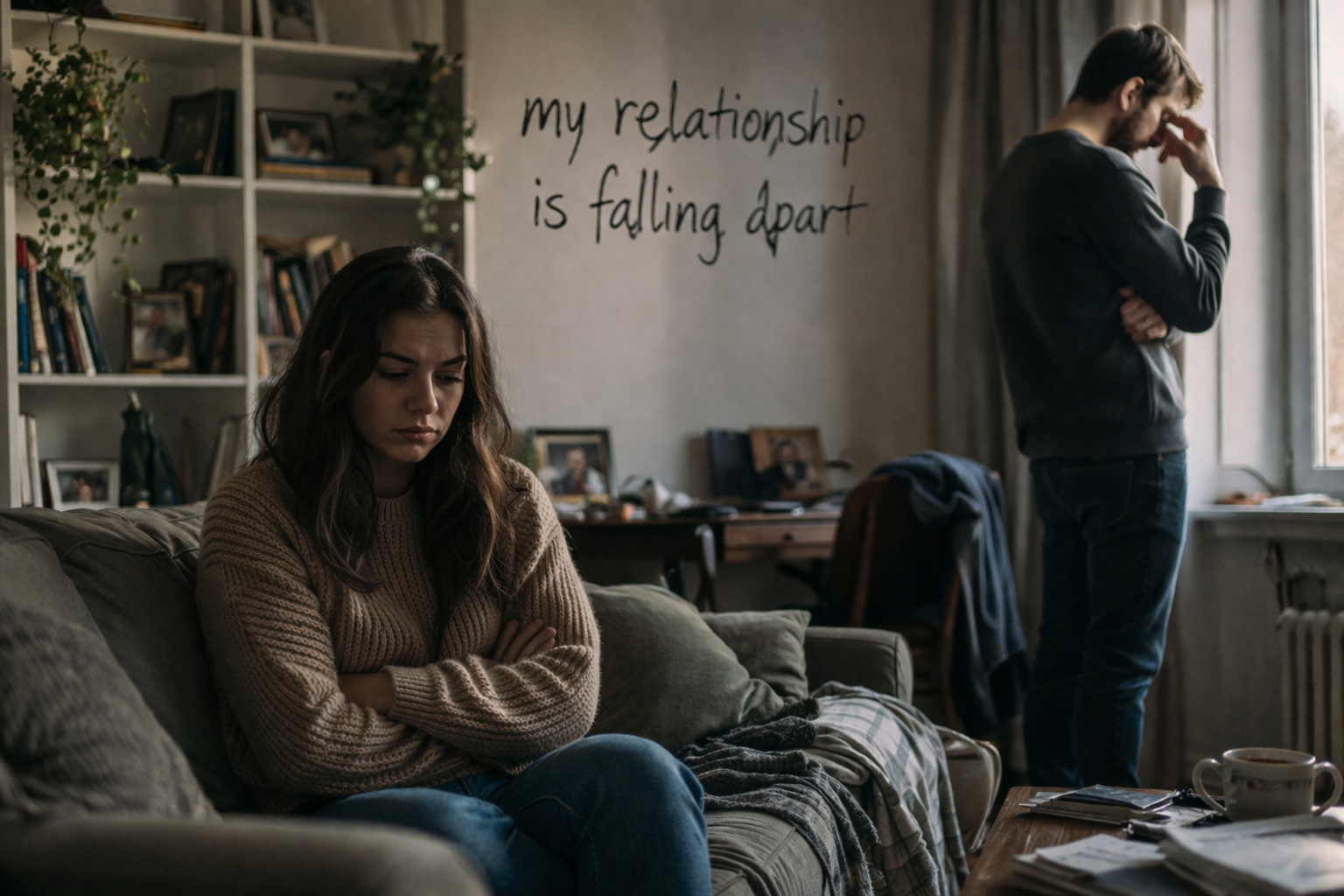
What It Really Means When Your Relationship Feels Like It’s Falling Apart
If you keep thinking “my relationship is falling apart,” it rarely means everything suddenly broke overnight. What’s actually happening, in most cases, is a gradual emotional drift—a slow shift from connection to disconnection that happens so quietly you barely notice it at first.
In the early stages, the signs are subtle:
- Conversations become more about logistics than feelings
- You stop sharing your thoughts as openly as you used to
- Small misunderstandings go unresolved instead of being talked through
At this point, it doesn’t feel like a crisis—it feels like distance.
As time goes on, that distance deepens. You may start to feel:
- Emotionally alone, even when you’re together
- Misunderstood or unheard during conversations
- Less interested in spending time together
- Disconnected physically, not just emotionally
This is where many people begin to seriously think, “my relationship is falling apart.”
What’s important to understand is that this feeling is usually not caused by one big problem. It’s the result of repeated patterns—missed opportunities to connect, unresolved conflicts, and emotional needs that haven’t been expressed or met.
Another key layer is emotional safety. When one or both partners stop feeling safe to be vulnerable—whether due to criticism, defensiveness, or past hurt—they begin to withdraw. And once withdrawal becomes a habit, the relationship starts running on autopilot rather than intention.
But here’s the part many people overlook:
Feeling like your relationship is falling apart is also a moment of awareness.
It means something in the relationship is asking for attention.
And that matters, because awareness creates a choice:
- You can ignore it and allow the distance to grow
- Or you can face it, understand it, and begin to repair it
The truth is, many relationships that feel broken are not beyond saving. When both partners are willing to:
- Be honest (even when it’s uncomfortable)
- Take responsibility for their part
- Relearn how to communicate and connect
…it’s possible not just to fix the relationship, but to rebuild it into something stronger and more intentional than it was before.
So if you’re thinking “my relationship is falling apart,” don’t see it as the end.
See it as a signal—one that gives you a chance to either rebuild with purpose or make a clear, healthy decision about what comes next.
Why You Feel Like Your Relationship Is Falling Apart (And Why It Happens Slowly)
Relationships rarely break overnight. What feels like a sudden realization is often the result of months—or even years—of small emotional injuries, unmet needs, and poor communication stacking up.
At first, it’s easy to dismiss things:
- “We’re just stressed.”
- “It’s just a phase.”
- “Things will go back to normal.”
But over time, those small cracks widen.
When people say “my relationship is falling apart,” what they’re really describing is a growing emotional distance. The connection that once felt natural starts to feel forced. Conversations lose depth. Silence becomes more comfortable than honesty.
Understanding this gradual breakdown is important because it means one thing: if it can slowly fall apart, it can also be slowly rebuilt.
9 Clear Signs Your Relationship Is Falling Apart (Deeper Breakdown)
Recognizing these signs early is powerful. When you can clearly say “my relationship is falling apart,” it means you’re no longer ignoring what’s happening—and that awareness gives you a chance to respond before things reach a breaking point.
Here’s what each sign really looks like beneath the surface:
1. You Feel Emotionally Disconnected
This is often the first and most telling sign.
You might still live together, talk daily, and even function as a team—but the emotional bond feels missing. Conversations stay on the surface:
- “Did you pay the bill?”
- “What are we eating tonight?”
But deeper conversations—about feelings, fears, dreams—fade away.
You may also notice:
- You hesitate to open up because it feels pointless
- You don’t feel truly seen or understood anymore
- You feel lonely… even when you’re sitting right next to them
This kind of disconnection is usually where the thought “my relationship is falling apart” begins.
2. Communication Turns Into Conflict—or Disappears Entirely
Healthy relationships rely on safe, open communication. When that breaks down, two patterns usually appear:
Constant conflict:
Every conversation turns into an argument. Small topics escalate quickly, and both of you feel defensive or attacked.
Total avoidance:
Instead of arguing, you stop talking about anything meaningful altogether. You keep things in to avoid stress.
Over time, this creates:
- Misunderstandings that never get cleared up
- Emotional distance
- A feeling that you’re “on different wavelengths”
When communication fails, connection follows.
3. Intimacy Has Faded
Intimacy isn’t just physical—it’s emotional closeness.
When a relationship is struggling, you may notice:
- Less physical affection (hugs, kisses, touch)
- A decline in sexual connection
- A lack of emotional vulnerability
But the deeper issue is this:
You stop turning to each other for comfort, excitement, or support.
You’re no longer each other’s “safe place.”
And when intimacy fades, the relationship starts to feel more like a routine than a connection.
4. You’re Constantly Irritated by Each Other
When love is strong, you naturally overlook small flaws. But when disconnection grows, those same small things become triggers.
Suddenly:
- The way they talk annoys you
- Their habits feel unbearable
- You feel easily frustrated—even over minor issues
This irritation is often a symptom of unresolved emotions underneath—hurt, disappointment, or unmet needs.
It’s not really about what they’re doing… it’s about what’s been building up.
5. Resentment Is Building Beneath the Surface
Resentment is one of the most damaging forces in a relationship.
It develops when:
- Issues aren’t resolved properly
- Apologies don’t feel genuine
- Needs are repeatedly ignored
Instead of moving forward, you start keeping score:
- “I always do this, they never do that”
- “They hurt me before, and I haven’t forgotten”
Even when things seem calm, there’s tension underneath.
And over time, resentment quietly replaces empathy.
6. You Avoid Spending Time Together
When a relationship is healthy, you naturally want to be around each other.
But when things start falling apart:
- You stay busy to avoid interaction
- You spend more time on your phone, work, or with others
- You feel relief when they’re not around
This avoidance isn’t always intentional. Sometimes it’s just easier than facing the discomfort between you.
But the result is the same:
Less time together = less opportunity to reconnect.
7. Trust Feels Fragile or Broken
Trust is the foundation of emotional safety.
When it’s damaged—whether through:
- Lies
- Broken promises
- Emotional neglect
- Or betrayal
…it changes how you see each other.
You may start to:
- Question their intentions
- Feel insecure or guarded
- Hold back emotionally to protect yourself
Without trust, even small issues feel bigger—because the foundation no longer feels stable.
8. One or Both of You Become Controlling or Distant
As insecurity and disconnection grow, people tend to react in one of two ways:
Control:
Trying to regain stability by monitoring, questioning, or restricting the other person.
Withdrawal:
Emotionally shutting down, avoiding conversations, and becoming distant.
Both are protective responses—but they create a negative cycle:
- One person pushes → the other pulls away
- The more distance → the more control or frustration
This pattern accelerates the feeling that “my relationship is falling apart.”
9. You’ve Thought About Ending the Relationship
This is one of the clearest signs something isn’t working.
You might:
- Imagine life without them
- Wonder if you’d be happier alone
- Feel emotionally checked out
Even if you haven’t taken action, the thought itself matters.
It usually doesn’t come from nowhere—it comes from repeated unmet needs, emotional exhaustion, and unresolved pain.
Final Thought on the Signs
If you recognize several of these patterns, it doesn’t automatically mean your relationship is over.
But it does mean one thing clearly:
Something needs to change.
The earlier you acknowledge these signs, the more options you have—whether that’s repairing the relationship or making a healthy decision about your future.
And most importantly, if you’ve been thinking “my relationship is falling apart,” you’re not overreacting—you’re paying attention.
Toxic vToxic vs. Abusive Relationships: Know the Critical Difference (Deep Dive)
If you’ve been thinking “my relationship is falling apart,” one of the most important questions you can ask yourself is this:
Is this relationship unhealthy—or is it unsafe?
At a glance, toxic and abusive relationships can look similar. Both can involve arguments, emotional pain, and disconnection. But the difference between them is critical, because it determines your next step—whether to work on the relationship or protect yourself and get out.
What a Toxic Relationship Really Looks Like (And Why It Can Often Be Fixed)
A toxic relationship is built on unhealthy patterns, not power and control.
Both partners usually:
- Contribute to the problems (even if not equally)
- React emotionally rather than intentionally
- Get stuck in repeated negative cycles
You might notice patterns like:
- Constant criticism or blaming each other
- Frequent arguments that never fully resolve
- Emotional distance or inconsistency
- Saying hurtful things in the heat of the moment
But here’s the key difference:
There is still some level of mutual respect, care, or emotional connection underneath the dysfunction.
Even if things feel strained, you might still:
- Have moments where you genuinely enjoy each other
- Feel like your partner cares, even if they show it poorly
- Want to fix things (on both sides, at least sometimes)
In many cases, when someone says “my relationship is falling apart,” they are actually describing a toxic dynamic—not an abusive one.
Why Toxic Relationships Can Improve
Toxic patterns are often driven by:
- Poor communication habits
- Unresolved emotional wounds
- Stress, insecurity, or unmet needs
These are learned behaviors, which means they can be unlearned.
With:
- Honest self-reflection
- Better communication skills
- Clear boundaries
- And sometimes professional guidance
…many toxic relationships can transform into healthier, more stable ones.
What an Abusive Relationship Really Looks Like (And Why It’s Different)
An abusive relationship is not just unhealthy—it’s dangerous and imbalanced.
The core issue is power and control.
One partner consistently:
- Dominates the relationship
- Uses fear, guilt, or manipulation
- Undermines the other person’s independence or self-worth
This can show up in different forms:
- Emotional abuse: constant criticism, humiliation, gaslighting
- Psychological control: isolating you from friends or family
- Verbal abuse: insults, threats, yelling
- Physical abuse: any form of physical harm or intimidation
- Financial control: restricting access to money or resources
Key Signs You May Be in an Abusive Relationship
- You feel afraid of your partner’s reactions
- You walk on eggshells to avoid upsetting them
- You’ve changed your behavior, personality, or choices to keep peace
- You feel trapped, controlled, or powerless
- You’re often blamed for their behavior (“You made me do this”)
At this point, the thought “my relationship is falling apart” doesn’t fully capture what’s happening.
Because the issue isn’t just that the relationship is breaking down—
it’s that your safety, identity, and well-being are being compromised.
The Most Important Difference: Pattern vs Power
Here’s the simplest way to understand it:
- Toxic relationship = unhealthy patterns between two people
- Abusive relationship = one person holding power over the other
In toxic relationships:
- Both people can change
- Growth is possible with effort
In abusive relationships:
- Change is unlikely without serious intervention
- And even then, your safety must come first
Why This Distinction Matters So Much
Many people stay stuck because they confuse the two.
They think:
- “Every relationship has problems”
- “We just need to communicate better”
- “If I try harder, things will improve”
This mindset can help in a toxic relationship…
But in an abusive one, it can keep you trapped.
Because no amount of communication or effort can fix a situation where:
- One person is intentionally controlling or harming the other
- Accountability is missing
- Safety is not present
What You Should Do Next (Based on Your Situation)
If Your Relationship Is Toxic
Focus on repair:
- Improve communication
- Set boundaries
- Take responsibility for your role
- Consider therapy or guidance
There is often a path forward—if both people are willing.
If Your Relationship Is Abusive
Shift your focus immediately:
- Prioritize your safety
- Reach out to trusted people or support systems
- Seek professional or local support resources
This is not about saving the relationship.
It’s about protecting yourself.
Final Reality Check
If you’re saying “my relationship is falling apart,” take a moment to ask yourself honestly:
- Do we both contribute to the problems?
- Or do I feel controlled, afraid, or unsafe?
That answer changes everything.
Because while some relationships can be rebuilt with effort and understanding…
others require the courage to step away and choose your own well-being first.
What Causes a Relationship to Fall Apart? (The Hidden Patterns Most People Miss)
Most people focus on surface problems, but deeper patterns are usually the real cause.
Unmet Emotional Needs
When needs go unspoken—or ignored—disconnection grows.
Poor Communication Habits
Blame, defensiveness, and avoidance slowly damage trust and understanding.
Loss of Emotional Safety
If you don’t feel safe expressing yourself, you start shutting down.
Unresolved Past Conflicts
Old wounds that never healed continue to influence present behavior.
Life Stress and External Pressure
Work, finances, and family stress can quietly erode connection if not managed together.
How to Fix a Relationship That Feels Like It’s Falling Apart
If you’re asking “my relationship is falling apart, what can I do?”—this is where change begins.
1. Rebuild Honest Communication
Start small. Focus on expressing feelings, not blaming:
- Say: “I feel distant lately”
- Instead of: “You don’t care anymore”
Listen to understand—not to win.
2. Address Problems Early Instead of Avoiding Them
Avoidance might keep the peace temporarily, but it builds long-term resentment.
Create a habit of checking in regularly—even when things feel uncomfortable.
3. Rebuild Trust Through Consistency
Trust doesn’t come back through promises—it comes back through repeated, reliable actions.
- Follow through
- Be transparent
- Show emotional presence
4. Bring Back Emotional and Physical Intimacy
You don’t need grand gestures. Start simple:
- Spend uninterrupted time together
- Show small acts of affection
- Reconnect through shared experiences
5. Take Responsibility Without Shifting Blame
Healthy repair requires both partners to reflect:
- What am I doing that contributes to this?
- What can I change—even if my partner doesn’t?
6. Break the Negative Cycle
Most struggling couples repeat the same pattern:
Trigger → Argument → Withdrawal → Repeat
Identify your cycle—and consciously interrupt it.
When to Seek Professional Help (And Why It Can Change Everything)
Sometimes, no matter how hard you try, nothing improves. That’s a sign you may need outside help.
Consider support if:
- Arguments never get resolved
- You feel emotionally checked out
- Contempt or disrespect has developed
- You’re seriously considering ending things
Approaches like the Gottman Method and Emotionally Focused Therapy have helped many couples rebuild trust and connection.
Getting help isn’t failure—it’s strategy.
What If Only One of You Wants to Fix the Relationship?
This is one of the hardest situations.
You cannot force change—but you can influence it.
When one partner starts:
- Communicating differently
- Reacting with more awareness
- Setting healthier boundaries
…it often shifts the dynamic.
Even if it doesn’t save the relationship, it gives you clarity and emotional strength to decide what’s next.
How to Know When It’s Time to Let Go
Not every relationship is meant to be saved.
It may be time to walk away if:
- There’s ongoing abuse or fear
- Your needs are consistently ignored
- Effort is completely one-sided
- You feel more drained than fulfilled
Letting go doesn’t mean failure. Sometimes it’s the healthiest decision you can make.
Extra Insight #1: Why “Trying Harder” Often Makes Things Worse
Many people respond to relationship problems by trying harder—but in the wrong way.
They:
- Over-explain
- Over-pursue
- Overreact
This often pushes the other person further away.
Real change comes from doing things differently, not just doing more.
Extra Insight #2: How Small Daily Habits Can Save a Failing Relationship
Big changes are powerful—but small daily habits are what sustain relationships.
Simple habits that rebuild connection:
- 10-minute daily check-ins
- Expressing appreciation regularly
- Reducing phone distractions during time together
- Ending the day on a positive note
Consistency beats intensity every time.
Final Thoughts: Your Relationship Isn’t Over—But It Needs Attention
If you’ve been thinking “my relationship is falling apart,” don’t ignore that feeling. It’s not just anxiety—it’s awareness.
Relationships don’t fix themselves. But they can be rebuilt.
With honesty, effort, and the right approach, what feels broken today can become stronger than before.
The real question isn’t just:
“Is my relationship falling apart?”
It’s:
“Are we willing to do what it takes to rebuild it?”
