
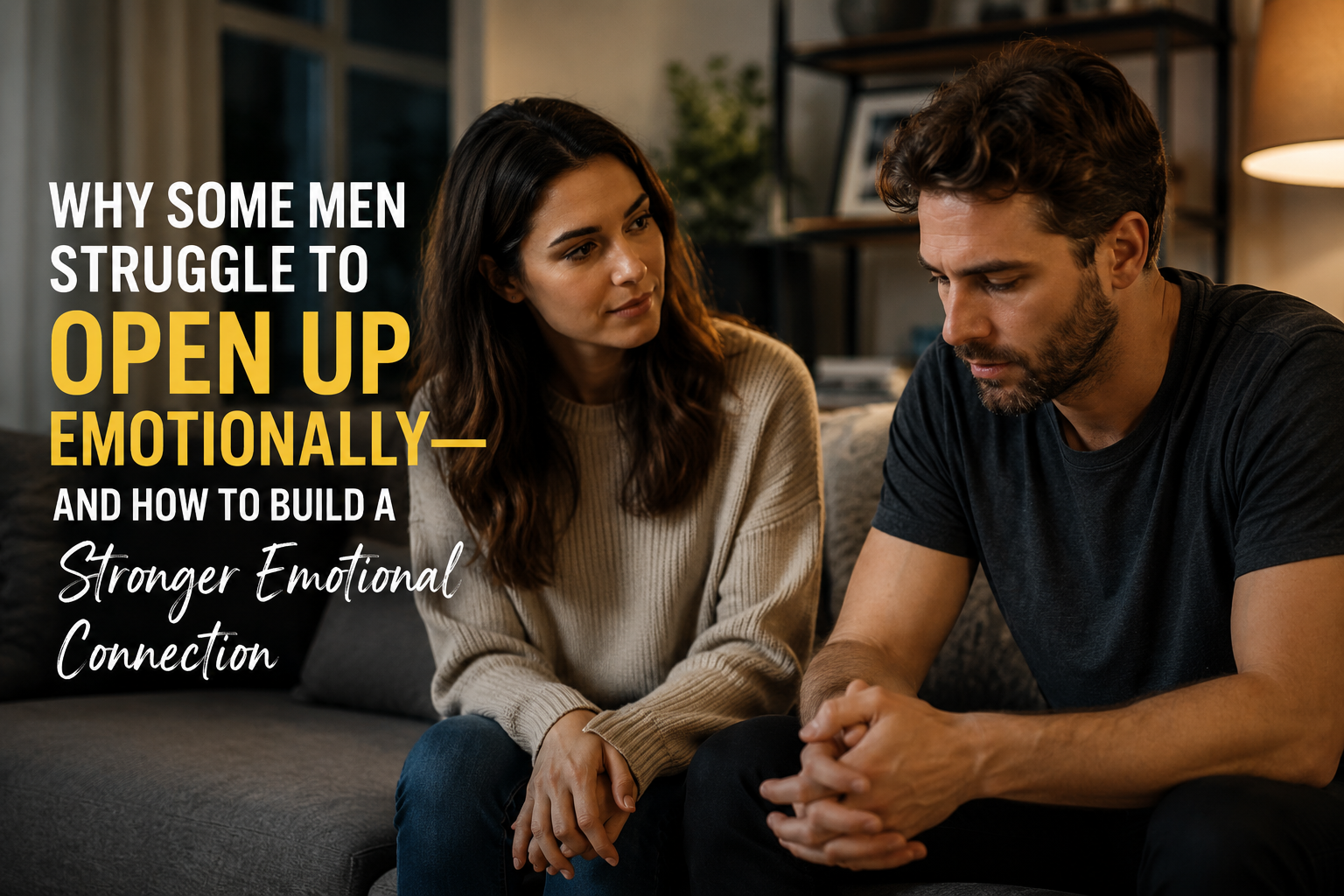
Understanding Emotional Intimacy in Relationships
Many women find themselves asking the same question:
“Why is it so difficult for him to talk about his feelings?”
Perhaps you’ve tried to start meaningful conversations, express your emotions, or create a deeper connection, only to receive short answers, silence, or what feels like emotional distance.
If this sounds familiar, you’re not alone.
The good news is that emotional unavailability doesn’t always mean a man doesn’t care. In many cases, it means he has never learned how to comfortably express emotions, especially within a romantic relationship.
Understanding why this happens can help you build a healthier, more connected partnership.
The Truth: Men Experience Emotions Too
One of the biggest misconceptions in modern dating is that men are less emotional than women.
Research in relationship psychology suggests that men experience a full range of emotions just as women do. The difference often lies in how emotions are processed, expressed, and communicated.
Many boys grow up receiving messages such as:
- “Be strong.”
- “Don’t cry.”
- “Handle it yourself.”
- “Don’t be too sensitive.”
Over time, these messages can teach men to suppress emotional expression rather than develop emotional communication skills.
As adults, they may feel emotions intensely while struggling to discuss them openly.
Why Some Men Shut Down During Emotional Conversations
Relationship researchers have found that emotionally charged conversations can affect partners differently.
While one person may process emotions by talking through them, another may become overwhelmed and withdraw.
When this happens, it doesn’t necessarily indicate a lack of love or concern.
Instead, it may reflect:
- Emotional overload
- Stress responses
- Fear of conflict
- Limited emotional vocabulary
- Lack of experience discussing feelings
This is why some men become quiet, defensive, or distant during difficult conversations.
Understanding this distinction can prevent unnecessary misunderstandings.
Emotional Connection Is a Skill, Not a Personality Trait
One of the most important lessons in successful relationships is that emotional intimacy is a skill that can be learned.
Many people assume emotional connection happens naturally.
In reality, healthy communication often develops through practice, patience, and mutual understanding.
Partners who enjoy strong emotional bonds typically learn:
- How to listen without judgment
- How to express needs clearly
- How to validate each other’s experiences
- How to discuss difficult topics respectfully
- How to create emotional safety
These skills are learned—not inherited.
Start With Empathy, Not Criticism
If you want your partner to open up more, focus on creating an environment where he feels understood rather than evaluated.
Empathy goes beyond feeling sorry for someone.
True empathy involves:
- Listening without interrupting
- Seeking to understand before responding
- Acknowledging emotions without immediately fixing the problem
- Showing curiosity about another person’s experience
For example, instead of saying:
“Why don’t you ever talk about your feelings?”
Try:
“I’d really like to understand what you’re experiencing right now. I’m here to listen.”
This small shift can dramatically change how a conversation unfolds.
Create Emotional Safety
People open up when they feel safe.
Emotional safety means knowing that vulnerability will not be met with ridicule, criticism, or dismissal.
To create emotional safety:
Avoid judgment
Focus on understanding rather than proving a point.
Stay calm during difficult discussions
Strong emotional reactions can sometimes cause a partner to become defensive.
Validate emotions
You don’t have to agree with every feeling to acknowledge it.
Be patient
Trust develops over time.
The more emotionally safe a relationship feels, the easier vulnerability becomes.
Shared Experiences Often Build Deeper Bonds
Interestingly, emotional connection doesn’t always begin with deep conversations.
Many people connect most naturally while doing activities together.
Examples include:
- Traveling
- Exercising
- Hiking
- Cooking
- Watching sports
- Volunteering
- Working on projects together
Shared experiences create opportunities for natural conversation and strengthen feelings of partnership.
Sometimes meaningful discussions emerge when neither person is actively trying to force them.
Don’t Underestimate the Power of Humor
Healthy relationships often include laughter.
Humor can:
- Reduce tension
- Build trust
- Increase emotional closeness
- Improve communication
- Strengthen friendship within a relationship
While serious conversations are important, so are moments of fun, playfulness, and lighthearted connection.
Many long-term couples report that laughter remains one of the strongest predictors of relationship satisfaction.
Emotional Growth Requires Effort From Both Partners
A common mistake in relationships is expecting one person to do all the emotional work.
Strong partnerships require mutual growth.
That means:
- One partner learns to communicate more openly.
- The other learns to listen more effectively.
- Both people become more aware of each other’s emotional needs.
Healthy relationships are not about changing someone into a different person.
They are about creating an environment where both individuals can grow together.
Choosing Emotional Compatibility Matters
While communication skills can improve, compatibility also plays a role.
Some individuals naturally value emotional intimacy more than others.
Before investing heavily in a relationship, ask yourself:
- Can we communicate respectfully?
- Are we both willing to grow?
- Do we share similar relationship goals?
- Is emotional connection important to both of us?
When both partners value emotional closeness, building a strong bond becomes significantly easier.
Final Thoughts
Many men struggle to open up emotionally not because they lack feelings, but because they may never have learned how to express them effectively.
The strongest emotional connections are built through:
- Empathy
- Emotional safety
- Patience
- Shared experiences
- Healthy communication
- Mutual effort
When both partners learn to understand each other’s communication styles, emotional intimacy becomes less about changing someone and more about creating a relationship where vulnerability feels safe.
And in that environment, meaningful connection has room to grow.
