
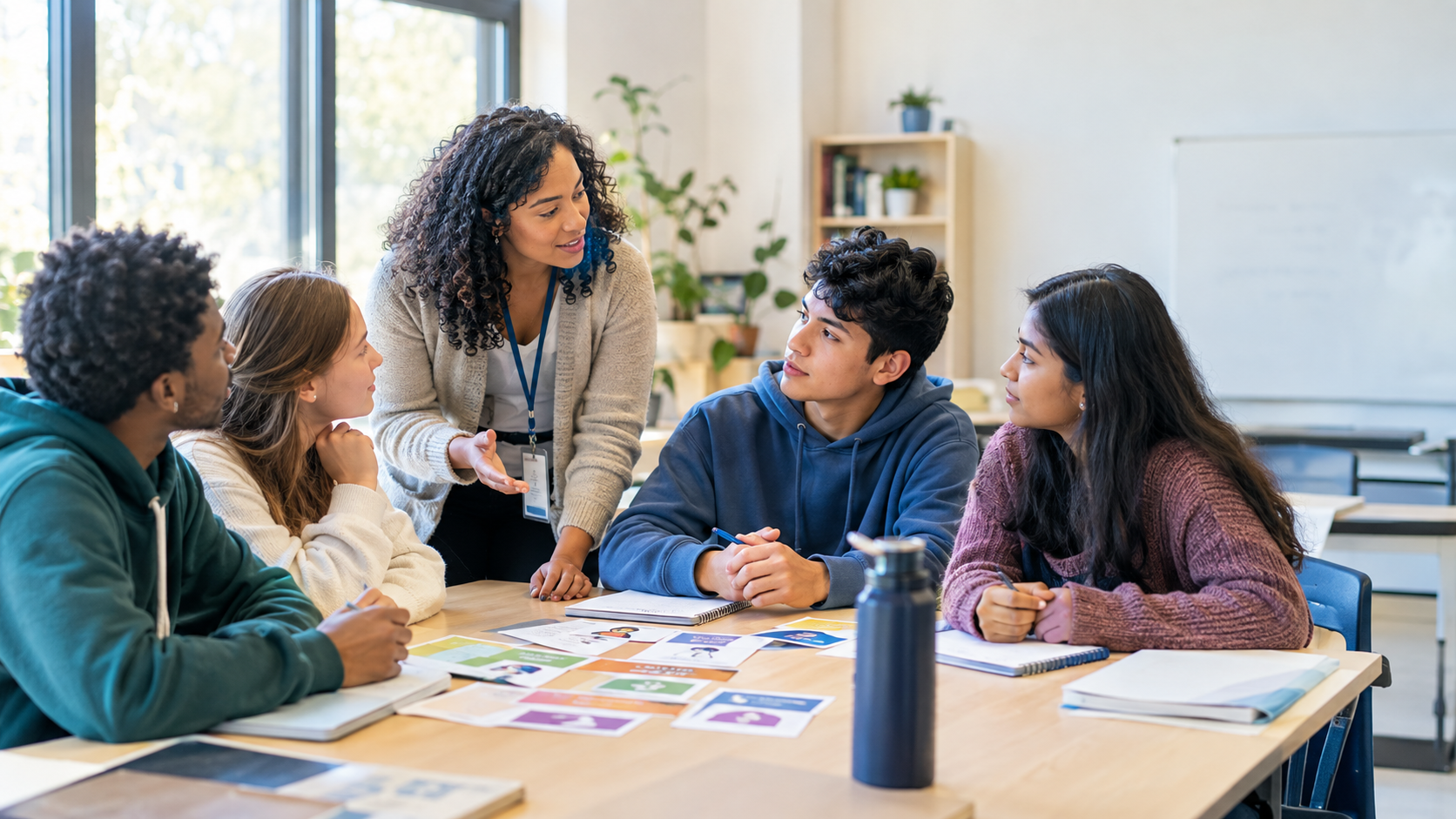
A healthy relationships curriculum is a structured educational program that teaches people the knowledge, attitudes, and practical skills needed to build respectful, supportive, safe, and healthy relationships.
A good curriculum goes beyond simply explaining what a healthy relationship looks like. It gives learners opportunities to practice communication, listening, empathy, decision-making, boundaries, conflict resolution, self-advocacy, and other relationship skills they can use in everyday life.
Healthy relationships education can be adapted for children, teenagers, young adults, adults, people with intellectual or developmental disabilities, students, employees, families, and community groups. The specific lessons should depend on the learners’ age, developmental needs, environment, culture, and educational goals.
This guide explains what a healthy relationships curriculum should include, how to structure one, useful lesson topics and activities, and how educators can make relationship education practical and accessible.
What Is a Healthy Relationships Curriculum?
A healthy relationships curriculum is a planned series of lessons and learning activities designed to help people understand and develop healthy relationship skills.
Depending on the audience, it may address relationships with:
- Friends
- Family members
- Classmates
- Teachers
- Coworkers
- Supervisors
- Acquaintances
- Romantic partners
- Community members
- Online contacts
A curriculum may include classroom discussions, role-playing, scenarios, visual activities, worksheets, group exercises, demonstrations, reflection questions, and take-home materials.
The central purpose is to help learners understand how healthy relationships work and how to participate in them respectfully and safely.
Rather than treating relationships as something people automatically know how to manage, a strong curriculum treats relationship skills as skills that can be learned, practiced, and improved.
What Does a Healthy Relationships Curriculum Teach?
Although programs vary, a comprehensive healthy relationships curriculum commonly covers:
- What healthy relationships look like
- Different types of relationships
- Respect
- Communication
- Active listening
- Emotional awareness
- Empathy
- Trust
- Personal boundaries
- Consent and personal autonomy
- Decision-making
- Conflict resolution
- Friendship skills
- Peer pressure
- Dating and romantic relationships
- Digital relationships
- Workplace relationships
- Recognizing unhealthy behavior
- Harassment and abuse prevention
- Self-advocacy
- Asking for help
- Personal safety
Not every curriculum needs to cover every subject in the same depth. The content should be selected according to the learners and the setting.
Why Is a Healthy Relationships Curriculum Important?
People interact with others every day, but relationship skills are not always taught systematically.
Someone may understand that respect is important without knowing how to communicate respectfully during a disagreement. A person may understand that boundaries matter but struggle to express a boundary clearly. Another learner may recognize that a relationship feels uncomfortable without knowing whether the behavior is simply a disagreement or a more serious warning sign.
A structured curriculum creates an opportunity to teach these skills explicitly.
It can help learners:
- Recognize healthy relationship characteristics
- Communicate thoughts and feelings
- Listen to other people
- Understand personal boundaries
- Respect other people’s boundaries
- Make thoughtful relationship decisions
- Handle disagreements constructively
- Recognize unhealthy behaviors
- Practice self-advocacy
- Seek help when necessary
- Develop confidence in social situations
The objective is not to create relationships without disagreement. Healthy relationships can involve differences of opinion, frustration, mistakes, and difficult conversations.
The objective is to help people handle those situations with respect, communication, appropriate boundaries, and safety.
Core Components of a Healthy Relationships Curriculum
A comprehensive curriculum should combine knowledge with practical skill-building.
1. Understanding Different Types of Relationships
Before discussing healthy relationships, learners need to understand that not every relationship has the same purpose or expectations.
A curriculum can introduce:
- Family relationships
- Friendships
- Acquaintances
- Classmate relationships
- Teacher-student relationships
- Coworker relationships
- Professional relationships
- Romantic relationships
- Online relationships
Learners can discuss how expectations change depending on the relationship.
For example, the amount of personal information appropriate to share with a close friend may be very different from what is appropriate to share with a coworker or acquaintance.
Understanding different relationship categories can help learners develop appropriate expectations and boundaries.
2. What Makes a Relationship Healthy?
One of the first major lessons should establish the characteristics of healthy relationships.
These can include:
- Respect
- Trust
- Honesty
- Communication
- Support
- Safety
- Fairness
- Appropriate boundaries
- Mutual consideration
- Freedom to have individual interests
- Ability to express disagreement
- Willingness to listen
- Shared responsibility
A healthy relationship does not require two people to agree about everything.
People can have different opinions, personalities, interests, and needs while still treating each other respectfully.
3. Healthy vs. Unhealthy Relationships
Learners should be able to recognize the difference between healthy relationship behaviors and concerning patterns.
| Healthy relationship behavior | Unhealthy relationship behavior |
|---|---|
| Respecting boundaries | Repeatedly ignoring boundaries |
| Honest communication | Persistent deception |
| Listening to concerns | Dismissing every concern |
| Shared decision-making | One person controlling decisions |
| Supporting friendships | Attempting to isolate someone |
| Respectful disagreement | Threats or intimidation |
| Personal independence | Excessive possessiveness |
| Mutual responsibility | Blaming one person for everything |
| Appropriate privacy | Intrusive monitoring |
| Encouraging self-advocacy | Punishing someone for speaking up |
This lesson should avoid suggesting that one isolated disagreement automatically means a relationship is unhealthy.
Instead, learners should look at patterns of behavior, respect, safety, power, and boundaries.
4. Communication Skills
Communication is one of the most important components of a healthy relationships curriculum.
Learners can practice how to:
- Express their feelings
- Explain what they need
- Ask questions
- Listen carefully
- Clarify misunderstandings
- Give feedback
- Disagree respectfully
- Discuss difficult subjects
- Ask for support
- Repair communication after conflict
A curriculum should include opportunities to practice communication rather than only defining it.
Example communication activity
Give learners a situation in which two people have misunderstood each other.
Ask:
- What happened?
- What did each person think was happening?
- What could they say differently?
- What questions could they ask?
- How could they resolve the misunderstanding?
This turns an abstract communication lesson into a practical skill.
5. Active Listening
Healthy communication involves both speaking and listening.
Learners can practice:
- Giving the speaker their attention
- Avoiding unnecessary interruptions
- Asking clarifying questions
- Summarizing what they heard
- Identifying emotions
- Checking whether they understood correctly
Active listening exercise
Place learners in pairs.
One person speaks for a short period about a neutral subject. The other listens without interrupting.
The listener then summarizes the speaker’s main points.
The speaker explains what was understood correctly and what was missed.
This simple exercise demonstrates why listening is an active skill rather than simply remaining silent while someone else talks.
6. Emotional Awareness
Relationships are influenced by emotions.
A healthy relationships curriculum can teach learners to recognize and describe feelings such as:
- Happiness
- Anger
- Sadness
- Fear
- Jealousy
- Loneliness
- Embarrassment
- Disappointment
- Frustration
- Excitement
Learners can also explore the difference between feeling an emotion and choosing a behavior.
For example, being angry does not automatically justify insulting, threatening, or hurting another person.
Understanding emotions can help learners pause and choose more constructive responses.
7. Empathy and Perspective-Taking
Empathy involves trying to understand another person’s experience.
A curriculum can teach learners to ask:
- How might this person feel?
- What might they be thinking?
- What information might I be missing?
- How can I show that I listened?
- Can I understand their perspective even if I disagree?
Scenario-based exercises are particularly useful for this lesson.
8. Boundaries and Personal Space
Boundaries are a fundamental part of healthy relationships.
Depending on the age and setting, learners can explore boundaries involving:
- Physical space
- Personal belongings
- Privacy
- Time
- Communication
- Emotional information
- Digital accounts
- Physical affection
- Personal decisions
Learners should understand both sides of boundaries:
Setting a boundary means communicating what you are comfortable with and what you will do when a boundary is not respected.
Respecting a boundary means taking another person’s stated limits seriously.
Boundary practice activity
Give learners several everyday scenarios and ask them to practice responding.
For example:
- Someone wants to borrow something without asking.
- A friend repeatedly calls late at night.
- A coworker asks an overly personal question.
- Someone wants to share another person’s private information.
Learners can practice simple responses such as:
“I’m not comfortable with that.”
“Please ask me before using my belongings.”
“I’d rather not discuss that.”
The goal is to develop practical communication skills.
9. Consent and Personal Autonomy
Where appropriate for the learners’ age and educational setting, consent should be addressed clearly and developmentally appropriately.
Learners can explore the idea that people have the right to make decisions about their own bodies, personal space, and appropriate interactions.
Lessons can explain that:
- Agreement should be voluntary.
- People can change their minds.
- Pressure is different from freely given agreement.
- Personal boundaries deserve respect.
- A person should not be punished for communicating a reasonable boundary.
The exact content should be adapted to age, developmental level, local educational requirements, and safeguarding standards.
10. Decision-Making and Self-Advocacy
Healthy relationships require people to make decisions and communicate their needs.
Self-advocacy lessons can help learners practice:
- Saying what they want
- Saying what they do not want
- Asking questions
- Seeking clarification
- Asking for support
- Making informed choices
- Speaking up when something feels wrong
- Identifying trusted people who can help
A useful decision-making framework is:
Stop → Think → Consider choices → Identify consequences → Ask for help if needed → Decide → Review
This framework can be adapted for different ages and abilities.
11. Conflict Resolution
Conflict is normal in relationships.
The goal of conflict-resolution education is not to eliminate disagreement but to teach people constructive ways of handling it.
A curriculum can introduce a process such as:
Pause → Listen → Explain → Understand → Problem-solve → Agree → Follow up
Learners can practice:
- Taking a break when emotions become overwhelming.
- Identifying the actual disagreement.
- Listening to each person’s perspective.
- Explaining concerns without unnecessary personal attacks.
- Identifying possible solutions.
- Agreeing on realistic next steps.
- Checking later to see whether the solution worked.
However, not every situation should be handled through direct negotiation. Threats, violence, coercion, intimidation, or serious safety concerns may require support from an appropriate adult, professional, safeguarding service, or other resource.
12. Friendship and Peer Relationships
Healthy relationships education should not focus exclusively on romantic relationships.
Friendships give learners opportunities to practice many of the same skills.
Lessons can cover:
- Making friends
- Maintaining friendships
- Sharing
- Taking turns
- Including others
- Handling jealousy
- Dealing with disagreements
- Apologizing
- Forgiving
- Respecting differences
- Recognizing unhealthy friendship patterns
- Ending friendships respectfully when appropriate
13. Dating and Romantic Relationships
For age-appropriate audiences, the curriculum can introduce romantic relationships.
Topics may include:
- Healthy expectations
- Communication
- Trust
- Boundaries
- Consent
- Emotional support
- Independence
- Jealousy
- Conflict
- Peer pressure
- Digital communication
- Recognizing controlling behavior
- Seeking help
The emphasis should remain on skills rather than presenting one ideal relationship model.
14. Digital and Online Relationships
Relationship education increasingly needs to include digital communication.
Learners can explore:
- Texting
- Social media
- Online friendships
- Digital privacy
- Sharing personal information
- Passwords and account security
- Online pressure
- Unwanted messages
- Digital harassment
- Social-media conflict
- Sharing private content
- Digital monitoring
A useful activity is to provide examples of online conversations and ask learners to identify respectful, unclear, inappropriate, or concerning communication.
15. Workplace Relationships
Workplace relationships deserve their own curriculum component, particularly for young adults and people preparing for employment.
Learners may need to understand the difference between:
- Coworkers
- Supervisors
- Customers
- Managers
- Friends
- Acquaintances
- Professional contacts
Lessons can cover:
- Appropriate workplace communication
- Professional boundaries
- Privacy
- Personal space
- Workplace harassment
- Asking for help
- Handling disagreements
- Respecting coworkers
- Understanding workplace rules
- Distinguishing personal and professional relationships
For people with intellectual and developmental disabilities, workplace relationship education can be particularly practical when it uses accessible language, visual materials, role-play, and real-life employment scenarios.
16. Recognizing Unhealthy or Abusive Behavior
A comprehensive curriculum should help learners recognize behaviors that may create an unsafe relationship.
Warning signs can include:
- Threats
- Intimidation
- Physical violence
- Coercion
- Repeated humiliation
- Excessive control
- Isolation
- Persistent monitoring
- Sexual coercion
- Financial control
- Repeated boundary violations
- Harassment
Learners should also understand where they can seek help.
The curriculum should avoid blaming someone for another person’s harmful behavior.
Sample Healthy Relationships Curriculum: 12-Lesson Structure
A practical curriculum can be organized into a sequence of lessons.
Lesson 1: Understanding Relationships
Goal: Identify different types of relationships and understand why relationships have different expectations.
Activities:
- Relationship sorting
- Scenario discussion
- Relationship-map activity
Lesson 2: What Makes a Relationship Healthy?
Goal: Identify respect, trust, communication, safety, boundaries, and support.
Activities:
- Healthy relationship scenario cards
- Group discussion
- Healthy vs. unhealthy behavior sorting
Lesson 3: Communication
Goal: Practice expressing thoughts, feelings, needs, and concerns.
Activities:
- Communication role-play
- “I” statement practice
- Miscommunication scenarios
Lesson 4: Active Listening and Empathy
Goal: Develop listening and perspective-taking skills.
Activities:
- Paired listening exercise
- Emotion-identification activity
- Perspective-taking scenarios
Lesson 5: Boundaries and Personal Space
Goal: Understand, communicate, and respect boundaries.
Activities:
- Boundary scenarios
- Appropriate/inappropriate behavior sorting
- Boundary-setting role-play
Lesson 6: Decision-Making and Self-Advocacy
Goal: Help learners make choices and communicate their needs.
Activities:
- Decision-making scenarios
- Speaking-up practice
- “Who can help?” exercise
Lesson 7: Conflict Resolution
Goal: Develop constructive approaches to disagreements.
Activities:
- Conflict scenarios
- Role-play
- Problem-solving exercise
Lesson 8: Friendship and Peer Relationships
Goal: Build healthy friendships and respond to peer pressure.
Activities:
- Friendship scenario cards
- Peer-pressure role-play
- Supportive-friend behavior sorting
Lesson 9: Romantic Relationships and Consent
Goal: Where age-appropriate, explore healthy dating relationships, boundaries, autonomy, and consent.
Activities:
- Scenario discussion
- Boundary practice
- Healthy relationship characteristics
Lesson 10: Digital Relationships
Goal: Develop healthy online communication and digital boundaries.
Activities:
- Text-message scenarios
- Privacy exercise
- Social-media decision-making
Lesson 11: Recognizing Unhealthy Relationships
Goal: Identify warning signs and understand when to seek help.
Activities:
- Warning-sign scenarios
- Safety discussion
- Support-network exercise
Lesson 12: Review, Practice, and Personal Action Plan
Goal: Reinforce the skills learned throughout the curriculum.
Activities:
- Review quiz
- Role-play
- Personal reflection
- Relationship-skills action plan
This 12-lesson structure is a sample framework, not a description of any particular commercial curriculum.
Healthy Relationships Curriculum Activities
The best relationship lessons are interactive.
Role-Playing
Role-play allows learners to practice conversations before encountering similar situations in real life.
Examples include:
- Saying no respectfully
- Asking for help
- Resolving a disagreement
- Responding to peer pressure
- Setting a boundary
- Clarifying a misunderstanding
- Communicating with a coworker
Sorting Activities
Learners can sort cards into categories such as:
- Healthy
- Unhealthy
- Needs more information
- Appropriate for this relationship
- Inappropriate for this relationship
Sorting is particularly useful for learners who benefit from visual and concrete activities.
Scenario Cards
Short scenarios can encourage discussion without requiring learners to disclose personal experiences.
For example:
A coworker repeatedly asks another employee personal questions after being asked to stop.
Questions:
- What is happening?
- Is the boundary being respected?
- What could the person say?
- Who could provide support?
Relationship Mapping
Learners can create a simple map showing different people in their lives and discussing how expectations may differ across relationships.
The activity can teach:
- Relationship categories
- Boundaries
- Trust
- Appropriate information sharing
- Support networks
Communication Practice
Give learners a situation and ask them to develop two responses:
- A response that may escalate the problem.
- A response that communicates the concern more constructively.
Then discuss the differences.
Making a Healthy Relationships Curriculum Accessible
Not every learner benefits from the same teaching method.
A curriculum may need to be adapted using:
- Plain language
- Short instructions
- Visual examples
- Pictures
- Demonstrations
- Repetition
- Role-play
- Concrete scenarios
- Step-by-step instructions
- Accessible worksheets
- Extra processing time
- Alternative communication methods
For people with intellectual and developmental disabilities, accessibility should be considered throughout the curriculum rather than added at the end.
The goal is not simply to simplify the subject. It is to make the concepts understandable and usable.
Who Can Use a Healthy Relationships Curriculum?
A healthy relationships curriculum can be adapted for:
- Schools
- Colleges
- Universities
- Youth programs
- Community organizations
- Disability services
- Employment programs
- Workplace training
- Counseling and education programs
- Family education programs
- Social-skills programs
The instructor may be a teacher, counselor, educator, social worker, job coach, youth worker, facilitator, or another appropriately trained professional, depending on the setting and subject matter.
For sensitive topics, instructors should also understand safeguarding procedures and know how to respond if a learner discloses a safety concern.
How to Teach a Healthy Relationships Curriculum
Create a Respectful Learning Environment
Before beginning, establish expectations such as:
- Listen to others.
- Do not ridicule questions.
- Respect different perspectives.
- Do not pressure anyone to share personal experiences.
- Protect other people’s privacy.
- Ask for clarification when something is unclear.
Use Realistic Examples
Relationship education becomes more useful when learners can connect concepts with everyday situations.
Use examples from:
- School
- Friendships
- Families
- Work
- Community settings
- Online communication
Use Practice, Not Just Explanation
A learner may be able to define “boundary” without being able to communicate one.
That is why practice is essential.
The curriculum should allow learners to:
Learn → Observe → Practice → Receive feedback → Practice again → Apply
Avoid Shame-Based Teaching
Relationship education should create space for questions and learning.
The purpose is to teach skills, safety, respect, communication, and informed decision-making rather than shame people for not already knowing something.
How to Assess a Healthy Relationships Curriculum
Assessment should determine whether learners can actually apply the skills.
Possible methods include:
Knowledge Checks
Short quizzes can test understanding of basic concepts.
Scenario-Based Assessment
Give learners a realistic situation and ask what they would do.
Role-Play Assessment
Learners demonstrate communication, boundary-setting, listening, or conflict-resolution skills.
Reflection
Learners can identify:
- One skill they learned
- One skill they practiced
- One situation where the skill could be useful
- Where they could seek help if needed
Instructor Observation
Teachers can observe whether learners demonstrate skills during activities.
What Should Be Included in a Curriculum Package?
If you are creating a complete healthy relationships curriculum for educators, a useful package can include:
- Instructor guide
- Lesson plans
- Learning objectives
- Lesson scripts or teaching notes
- Worksheets
- Handouts
- Scenario cards
- Visual materials
- Role-play instructions
- Discussion questions
- Assessment activities
- Review materials
- Accessibility guidance
- Safeguarding guidance
- Parent or caregiver information where appropriate
- Optional presentation slides
A curriculum does not need every item above, but the more practical teaching support it provides, the easier it may be for instructors to implement consistently.
How to Choose a Healthy Relationships Curriculum
If you are selecting an existing program, consider:
1. Target Audience
Is it designed for children, adolescents, adults, employees, people with disabilities, or another population?
2. Learning Objectives
Are the outcomes clearly stated?
3. Practical Activities
Does the program allow learners to practice skills?
4. Accessibility
Can learners with different communication, cognitive, sensory, or learning needs participate?
5. Instructor Support
Does the program provide lesson plans, teaching notes, scripts, handouts, or other resources?
6. Safety and Safeguarding
Does it appropriately address unhealthy behavior and explain how learners can seek help?
7. Cultural and Educational Fit
Does the material make sense for the community and educational environment where it will be used?
8. Adaptability
Can lessons be adjusted without losing their core learning objectives?
What Makes a Healthy Relationships Curriculum Effective?
An effective curriculum is not necessarily the longest curriculum.
Its value comes from how well it helps learners understand and apply relationship skills.
A strong program should be:
Practical: Learners can use the skills in everyday situations.
Age-appropriate: Lessons match developmental needs.
Accessible: Learners can understand and participate.
Interactive: Students have opportunities to practice.
Skills-based: The program teaches behaviors, not just definitions.
Inclusive: Different backgrounds and relationship experiences are respected.
Safety-conscious: Learners know how to recognize serious concerns and seek help.
Adaptable: Educators can modify examples and activities for their setting.
Well-structured: Lessons build logically from basic concepts to more complex skills.
Healthy Relationships Curriculum for Different Age Groups
Early Childhood
Focus on:
- Friendship
- Kindness
- Sharing
- Taking turns
- Emotions
- Personal space
- Saying no
- Asking trusted adults for help
Elementary School
Add:
- Respect
- Empathy
- Communication
- Conflict resolution
- Friendship problems
- Bullying
- Boundaries
- Emotional regulation
Middle School
Introduce:
- Peer pressure
- Digital communication
- Boundaries
- Respect
- Friendship conflict
- Early romantic relationships where appropriate
- Consent education appropriate to age
- Unhealthy relationship behaviors
High School
Expand into:
- Dating relationships
- Communication
- Consent
- Emotional intimacy
- Digital relationships
- Peer pressure
- Conflict
- Relationship decision-making
- Coercion and abuse prevention
- Support systems
Adults and Workplace Learners
Focus on:
- Professional relationships
- Workplace boundaries
- Communication
- Conflict resolution
- Self-advocacy
- Personal and professional relationships
- Harassment prevention
- Digital communication
- Long-term relationships
- Family relationships
Frequently Asked Questions About Healthy Relationships Curriculum
What is a healthy relationships curriculum?
A healthy relationships curriculum is a structured educational program that teaches practical skills for developing respectful, supportive, safe, and healthy relationships.
What topics are included in a healthy relationships curriculum?
Common topics include communication, active listening, respect, empathy, boundaries, consent, decision-making, conflict resolution, friendship, dating, digital relationships, workplace relationships, unhealthy relationship warning signs, self-advocacy, and help-seeking.
What are the main goals of a healthy relationships curriculum?
The main goals are to help learners understand healthy relationship behaviors, communicate effectively, establish and respect boundaries, manage disagreements, make informed decisions, recognize unhealthy behavior, and know where to seek support.
At what age should healthy relationships education begin?
Age-appropriate relationship education can begin during early childhood with concepts such as friendship, kindness, emotions, personal space, boundaries, and seeking help. More complex topics can be introduced as learners develop.
What activities can be used in a healthy relationships curriculum?
Useful activities include role-playing, scenario cards, sorting exercises, communication practice, active-listening exercises, relationship mapping, reflection, group discussion, quizzes, and problem-solving activities.
Should a healthy relationships curriculum include workplace relationships?
It can. Workplace relationships are particularly relevant for older students, young adults, employees, and people preparing for employment. Lessons can address professional boundaries, communication, coworkers, supervisors, harassment prevention, privacy, and self-advocacy.
Should healthy relationships curriculum include digital relationships?
Yes, particularly for learners who regularly communicate through phones, messaging platforms, gaming communities, or social media. Digital relationship education can address privacy, respectful communication, online pressure, harassment, and digital boundaries.
How long should a healthy relationships curriculum be?
There is no single ideal length. A curriculum can consist of a short workshop, several sessions, or a multi-lesson program. The appropriate length depends on the audience, learning objectives, available time, and complexity of the topics.
What is the difference between a healthy relationships curriculum and relationship advice?
A curriculum is an organized educational program with learning objectives, lessons, activities, and assessments. Relationship advice generally provides guidance about a particular situation or relationship.
Can a healthy relationships curriculum be adapted for people with intellectual or developmental disabilities?
Yes. It can be adapted using accessible language, visual materials, repetition, concrete examples, role-play, structured activities, and other appropriate teaching strategies. The adaptation should be based on the learners’ individual communication and learning needs.
Healthy Relationships Curriculum: Final Takeaway
A healthy relationships curriculum should do more than provide a list of relationship rules.
It should give learners practical opportunities to understand relationships, communicate clearly, listen to others, recognize emotions, establish boundaries, make decisions, resolve disagreements, practice self-advocacy, recognize unhealthy behavior, and seek appropriate support.
The strongest curriculum combines knowledge with practice.
Learners should not only be able to answer, “What is a healthy relationship?” They should also be able to demonstrate what healthy communication looks like, recognize when a boundary is being crossed, respond appropriately to conflict, identify concerning behaviors, and know where to turn for help.
Whether the curriculum is being used in a school, youth program, disability service, employment program, community organization, or workplace, the same basic principle applies: relationship skills are learnable skills.
With age-appropriate lessons, realistic scenarios, interactive activities, accessible teaching materials, and opportunities for repeated practice, a healthy relationships curriculum can turn abstract ideas such as respect, communication, boundaries, and empathy into skills learners can use in real life.
