
What makes a healthy relationship? Is it the love two people share, how much time they spend together, or how well they understand each other? Although these things can contribute to a strong connection, a healthy relationship requires much more than romantic feelings.
A healthy relationship is built on trust, mutual respect, honest communication, emotional safety, and a willingness to support each other’s growth. It is a partnership in which both people feel valued, heard, and accepted without having to sacrifice their individuality to keep the relationship alive.
However, even couples who genuinely love each other experience disagreements, misunderstandings, and difficult moments. No relationship is perfect, and expecting your partner to meet every need or agree with every decision is unrealistic. What matters is how both people handle challenges, communicate their concerns, and treat each other when things become difficult.
For example, a healthy couple can disagree about finances without insulting each other. They can spend time apart without assuming that their relationship is falling apart. They can express their feelings honestly without constantly fearing rejection, humiliation, or punishment.
Understanding the qualities of a healthy relationship can help you recognize whether your current partnership provides the respect, security, and connection you need. It can also help you identify areas where you and your partner can improve.
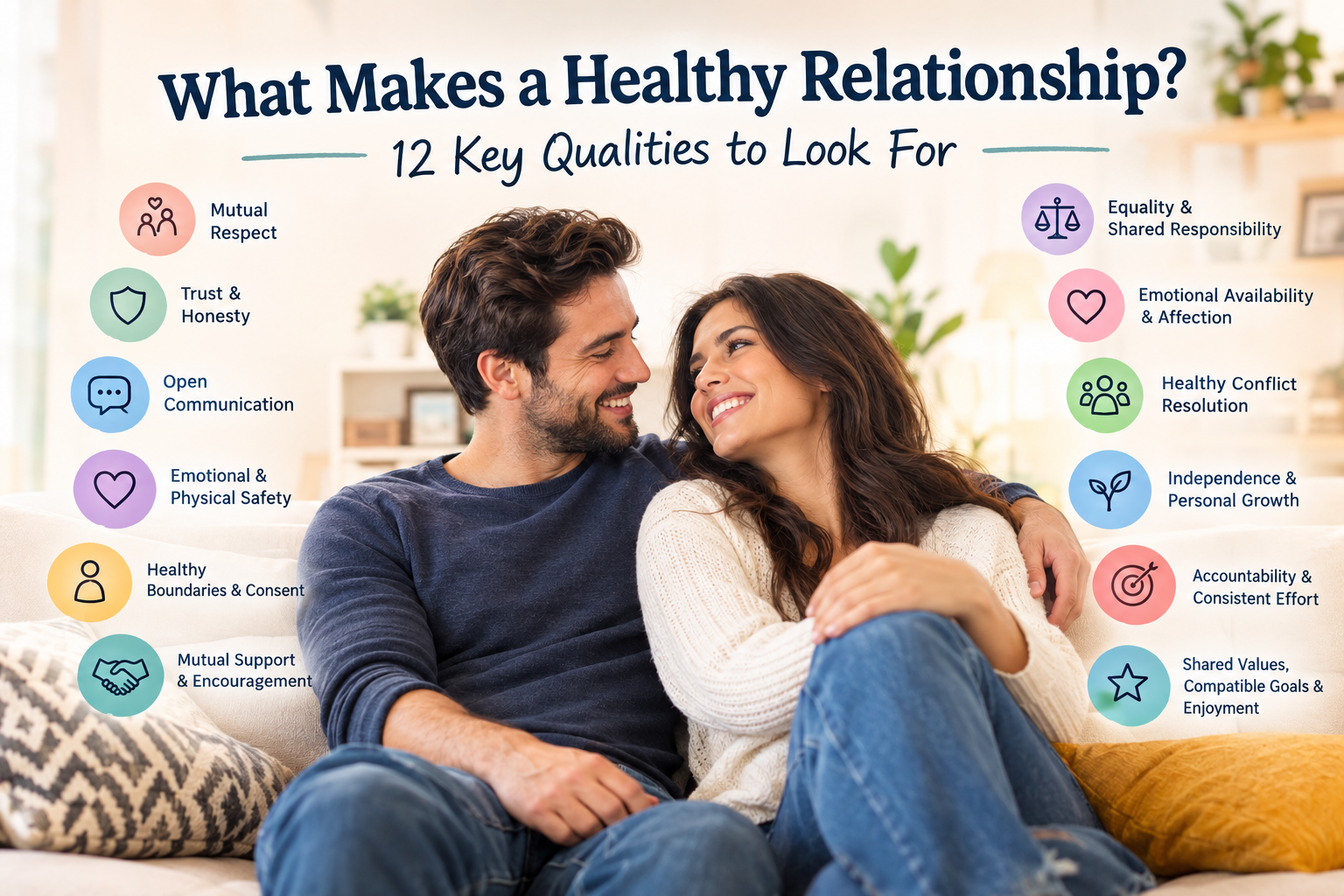
In this guide, we explore 12 key qualities of a healthy relationship, what they look like in everyday life, and how you can develop them to build a stronger and more fulfilling connection.
What Makes a Healthy Relationship?
A healthy relationship is a partnership in which both individuals feel respected, emotionally and physically safe, valued, and supported. It allows each person to express their feelings, communicate their needs, maintain personal independence, and work toward shared goals without experiencing constant control or disrespect.
Healthy relationships are not defined by the absence of conflict. Instead, they are characterized by how partners manage disagreements, take responsibility for their actions, and make an effort to understand each other.
For instance, one partner may need more time alone, while the other prefers spending most of their free time together. In a healthy relationship, both can communicate these preferences and find an arrangement that respects their individual needs.
Similarly, partners may have different opinions about money, family responsibilities, or future plans. They do not have to agree on everything, but they should be able to discuss important differences honestly and respectfully.
A healthy relationship also provides room for personal growth. Both individuals can maintain friendships, pursue their interests, and develop their identities while continuing to build emotional intimacy.
Ultimately, a healthy relationship is not simply about finding someone you love. It is about developing a partnership in which both people consistently demonstrate care, respect, honesty, and responsibility.
12 Key Qualities of a Healthy Relationship
Every relationship is different, but certain qualities help create a strong foundation for lasting emotional connection. These characteristics can help you understand what a healthy partnership looks like and what to look for in your relationship.
1. Mutual Respect
Mutual respect is one of the most important qualities of a healthy relationship. It means recognizing that your partner is an individual with their own feelings, opinions, beliefs, boundaries, and ambitions.
Respect does not require you to agree with everything your partner says or does. Instead, it means treating their thoughts and feelings as important, even when you have a different perspective.
In a respectful relationship, neither partner believes they have the right to control the other’s decisions simply because they are in love.
For example, imagine that you and your partner have different opinions about how to spend your weekend. You want to visit your family, while your partner prefers staying home and relaxing.
A respectful partner does not automatically dismiss your preference or make you feel guilty for wanting to see your family. Instead, both of you discuss your plans and look for an arrangement that works.
Mutual respect is also reflected in everyday actions, such as listening when your partner speaks, appreciating their contributions, and avoiding hurtful language during disagreements.
Signs of mutual respect include:
- Listening to each other’s opinions without ridicule.
- Respecting personal choices and individual differences.
- Avoiding insults, humiliation, and belittling comments.
- Considering each other’s feelings when making important decisions.
- Appreciating each other’s efforts and contributions.
- Respecting boundaries, even when they are different from your own.
Respect becomes particularly important during difficult conversations. A partner who respects you can disagree with your opinion without attacking your character.
How to build mutual respect: Listen carefully, avoid making assumptions about your partner’s intentions, and communicate disagreements without insults or threats. Remember that respect should be mutual rather than something only one person is expected to provide.
2. Trust and Honesty
Trust is the confidence that you can rely on your partner to treat you with honesty, consideration, and consistency. It creates a sense of security that allows both people to develop emotional intimacy without constantly questioning each other’s intentions.
In a healthy relationship, trust is built through repeated actions rather than romantic promises alone.
For example, if your partner promises to call you after work, following through consistently helps establish reliability. If plans change, communicating honestly can prevent unnecessary misunderstandings.
Honesty is equally important because trust becomes difficult to maintain when partners regularly hide important information, make false promises, or deliberately mislead each other.
Being honest does not mean sharing every private thought or giving up personal privacy. Healthy partners can maintain individual boundaries while being truthful about matters that affect their relationship.
Trust also involves allowing each other to maintain friendships, pursue personal interests, and spend time independently without constant suspicion.
However, trust can be damaged by dishonesty, broken promises, or repeated behavior that contradicts what a partner says. Rebuilding it requires patience, accountability, and consistent changes in behavior.
Signs of trust and honesty include:
- Keeping reasonable promises and commitments.
- Being truthful about important matters.
- Feeling comfortable discussing concerns.
- Respecting each other’s privacy.
- Taking responsibility when mistakes happen.
- Demonstrating consistency between words and actions.
How to build trust: Be honest even when a conversation is uncomfortable, follow through on your commitments, and acknowledge mistakes rather than hiding them. If trust has been damaged, discuss what both partners need to feel secure and whether meaningful change is taking place.
3. Open and Healthy Communication
Healthy communication is the ability to express thoughts, feelings, needs, and concerns in a clear and respectful way. It helps couples understand each other and address problems before misunderstandings become resentment.
Communication involves more than talking. It also requires active listening, patience, empathy, and a willingness to consider another person’s perspective.
For example, suppose you feel that your partner has been spending less time with you. Instead of accusing them of no longer caring, you could say, “I’ve been missing the time we used to spend together. Can we plan an evening for just the two of us?”
This approach communicates your feelings without immediately blaming your partner. It also gives them an opportunity to explain their perspective.
Healthy communication is especially important when discussing sensitive subjects such as finances, intimacy, family expectations, or personal insecurities.
Both partners should feel that they can raise concerns without being consistently ignored, mocked, or punished for speaking honestly.
Good communication also means recognizing that not every conversation needs an immediate solution. Sometimes, your partner may simply need you to listen and understand what they are experiencing.
Signs of healthy communication include:
- Expressing feelings without attacking each other’s character.
- Listening without constantly interrupting.
- Asking questions rather than making assumptions.
- Discussing problems before resentment builds.
- Being willing to acknowledge different perspectives.
- Making an effort to understand each other’s needs.
How to improve communication: Set aside time for meaningful conversations, listen without immediately becoming defensive, and use specific examples when explaining your concerns. If emotions become overwhelming, take a break and agree on a time to continue the discussion.
4. Emotional and Physical Safety
Safety is the foundation of a healthy relationship. Both partners should feel physically and emotionally secure enough to express themselves, establish boundaries, and make personal decisions without fear of intimidation or harm.
Emotional safety means being able to share your feelings, vulnerabilities, and concerns without constantly worrying that your partner will humiliate you, threaten you, or deliberately use your honesty against you.
For example, if you have made a mistake, an emotionally safe relationship allows you to acknowledge it and discuss what happened without fearing that your partner will use the situation to repeatedly shame you.
Physical safety is equally essential. Neither partner should experience physical violence, threats, sexual coercion, or intimidation.
Safety also includes feeling comfortable saying no. Whether you are discussing physical affection, sexual intimacy, or an everyday activity, your decisions should be respected.
A healthy relationship does not require partners to agree on everything. However, disagreements should not involve violence, threats, or deliberate attempts to create fear.
Signs of safety include:
- Feeling comfortable expressing your feelings.
- Being able to disagree without fear of retaliation.
- Having your physical and sexual boundaries respected.
- Being free from threats, intimidation, and violence.
- Feeling able to ask for help when you need it.
- Knowing that personal vulnerabilities will not deliberately be used against you.
How to create safety: Respond to vulnerability with kindness, respect each other’s physical and emotional boundaries, and avoid threatening or intimidating behavior. If you feel unsafe, seek support from someone you trust or an appropriate local service.
5. Healthy Boundaries and Consent
Healthy boundaries are personal limits that protect your emotional well-being, privacy, time, physical space, and personal values. Consent is the freely given agreement to participate in an activity, particularly physical or sexual intimacy.
Both are essential because being in a relationship does not mean that either partner loses the right to make personal decisions.
For example, you may need time alone after a stressful day. Your partner may prefer discussing problems immediately. A healthy relationship allows you to communicate these different needs and agree on a way to handle them.
Boundaries can also involve friendships, finances, family relationships, personal devices, and the amount of time you spend together.
Consent is particularly important in physical and sexual relationships. Both partners should feel free to say yes or no without pressure, threats, manipulation, or guilt. Consent can also be withdrawn at any time.
For example, agreeing to kiss someone does not automatically mean agreeing to further physical intimacy. A partner should respect your decision if you change your mind.
Boundaries are not the same as controlling rules. You can communicate what behavior you are comfortable with and decide what you will do if your boundaries are repeatedly disregarded. However, you should not use boundaries as an excuse to control every aspect of your partner’s life.
Signs of healthy boundaries and consent include:
- Respecting each other’s need for privacy and personal space.
- Feeling comfortable saying no.
- Asking for and respecting consent.
- Discussing expectations about friendships and family.
- Avoiding pressure or guilt when a partner sets a limit.
- Recognizing that both partners have the right to make personal decisions.
How to maintain healthy boundaries: Discuss your expectations openly, ask your partner about their limits, and respect their decisions. Make sure that consent is freely given rather than assumed.
6. Mutual Support and Encouragement
A healthy relationship should provide a supportive environment in which both partners can pursue their goals, overcome challenges, and grow as individuals.
Mutual support means showing genuine interest in your partner’s well-being and making a reasonable effort to help when they need you. It also means allowing yourself to receive support rather than feeling that you must handle everything alone.
For example, if your partner wants to return to school, start a business, or pursue a different career, you can encourage them by listening to their plans, celebrating their progress, and offering practical help when appropriate.
Support is not limited to major life decisions. It can also involve comforting your partner after a difficult day, helping with household responsibilities, or simply listening when they need to talk.
However, support should not become a one-sided responsibility. Both people have emotional needs, personal limits, and responsibilities.
A supportive relationship also allows partners to celebrate each other’s achievements without jealousy becoming a source of conflict.
Signs of mutual support include:
- Celebrating each other’s achievements.
- Offering encouragement during difficult periods.
- Showing interest in each other’s goals.
- Listening when your partner needs emotional support.
- Sharing responsibilities when possible.
- Respecting each other’s limitations and needs.
How to build mutual support: Ask your partner what kind of support they need, show interest in their ambitions, and communicate your own needs. Remember that supporting someone does not mean solving every problem for them.
7. Equality and Shared Responsibility
Equality means that both partners have a meaningful voice in the relationship and that neither person consistently dominates the other’s decisions.
A healthy relationship does not require every responsibility to be divided equally at all times. Couples may have different financial situations, working schedules, family responsibilities, or personal strengths.
What matters is that both partners consider their arrangement fair and that each person’s contributions are recognized.
For example, one partner may work longer hours while the other handles more household responsibilities. This can be a healthy arrangement when both partners agree to it and neither person’s contribution is treated as unimportant.
Equality also means making important decisions together. Choices involving money, family, living arrangements, and long-term commitments should allow both people to express their opinions.
Neither partner should automatically have more authority because of their income, age, gender, or position in the relationship.
Signs of equality and shared responsibility include:
- Both partners having a voice in important decisions.
- Responsibilities being discussed and shared fairly.
- Each person’s contributions being appreciated.
- Financial decisions being handled transparently.
- Both partners being able to express their needs.
- Neither person consistently controlling the relationship.
How to maintain equality: Discuss expectations about responsibilities, listen to each other’s concerns, and review your arrangements when circumstances change. A fair partnership considers both people’s needs rather than expecting one person to do everything.
8. Emotional Availability and Affection
Emotional availability means being willing to connect with your partner, express your feelings, and respond to their emotional needs within reasonable limits.
A relationship can involve spending considerable time together without creating genuine emotional intimacy. Partners need opportunities to talk, share experiences, and demonstrate that they care about each other’s feelings.
Affection is one way of maintaining this connection. It can involve physical touch, kind words, thoughtful gestures, quality time, or practical acts of care.
For example, if your partner has had a difficult day, you might offer a comforting hug, listen to their concerns, or give them some quiet time if that is what they prefer.
People express affection differently. One partner may value verbal reassurance, while the other may feel loved through practical help or uninterrupted time together.
A healthy relationship involves learning how each person prefers to give and receive affection instead of assuming that both partners experience love in exactly the same way.
Emotional availability does not mean being available every minute. Both partners need time for work, rest, personal responsibilities, and other relationships.
Signs of emotional availability and affection include:
- Expressing love and appreciation regularly.
- Making time for meaningful conversations.
- Showing interest in each other’s emotional experiences.
- Offering affection in ways that feel comfortable to both partners.
- Being willing to discuss emotional needs.
- Making an effort to reconnect after periods of distance.
How to strengthen emotional connection: Ask your partner what makes them feel loved, share your own emotional needs, and create regular opportunities to spend meaningful time together.
9. Healthy Conflict Resolution
Disagreements are a normal part of romantic relationships. Two people may have different opinions, personalities, expectations, and ways of responding to stressful situations.
A healthy relationship is not one in which partners never argue. It is one in which they can address disagreements without consistently hurting, intimidating, or disrespecting each other.
Healthy conflict resolution focuses on understanding the problem and finding a workable solution rather than proving who is right.
For example, imagine that one partner feels neglected because the other spends most evenings working. Instead of exchanging accusations, they can discuss their schedules and find realistic opportunities to spend time together.
Healthy conflict also involves taking responsibility for hurtful behavior. If you say something that hurts your partner, acknowledging it and making an effort to change can help rebuild trust.
Sometimes, partners may need a break when emotions become overwhelming. Taking time to calm down can be helpful as long as both people agree to return to the conversation.
However, repeatedly ignoring problems, threatening a breakup to gain control, or using insults to win arguments can undermine emotional safety.
Signs of healthy conflict resolution include:
- Discussing disagreements without personal attacks.
- Listening to each other’s perspectives.
- Taking responsibility for mistakes.
- Apologizing sincerely when necessary.
- Looking for solutions rather than trying to win.
- Returning to difficult conversations after taking a break.
How to resolve conflicts constructively: Focus on the specific problem, communicate your feelings respectfully, and avoid bringing unrelated past disagreements into every argument. When possible, agree on practical steps to prevent the same issue from recurring.
10. Independence and Personal Growth
A healthy relationship brings two individuals together without requiring them to give up their identities.
Both partners should have opportunities to pursue personal interests, maintain friendships, develop new skills, and work toward individual goals.
Spending time apart does not automatically mean that a relationship is becoming weaker. Personal independence can help people maintain their identities and bring new experiences into their partnership.
For example, you may enjoy exercising or spending time with friends while your partner prefers reading or pursuing a creative hobby. You can support each other’s interests without needing to participate in every activity.
Personal growth also means allowing each other to change. Your partner may develop new ambitions, discover different interests, or reconsider some of their priorities over time.
Healthy couples communicate about these changes rather than expecting each other to remain exactly the same throughout the relationship.
However, independence should be balanced with commitment. Having personal interests does not mean neglecting shared responsibilities or consistently disregarding your partner’s needs.
Signs of independence and personal growth include:
- Maintaining friendships outside the relationship.
- Having personal interests and hobbies.
- Supporting each other’s ambitions.
- Respecting time spent alone.
- Encouraging learning and self-development.
- Allowing each other to grow and change.
How to encourage independence: Make time for your own interests, respect your partner’s personal activities, and celebrate each other’s progress. Build a relationship in which you can grow together without losing yourselves.
11. Accountability and Consistent Effort
A healthy relationship requires both partners to take responsibility for their actions and make consistent efforts to maintain their connection.
Accountability means recognizing when your behavior has hurt your partner, acknowledging your mistakes, and making a genuine effort to change.
For example, suppose you repeatedly cancel plans at the last minute. If your partner explains that this makes them feel unimportant, a healthy response involves listening, acknowledging the impact of your actions, and making more realistic commitments.
An apology can be an important first step, but meaningful accountability also requires changed behavior.
Consistent effort is equally important. A relationship cannot depend entirely on romantic gestures or promises made during difficult conversations. It also needs everyday actions that demonstrate care and consideration.
This might involve making time for each other, keeping commitments, discussing problems, and sharing responsibilities.
Accountability should be mutual. One partner should not be expected to apologize for every disagreement or carry all the responsibility for maintaining the relationship.
It is also important to recognize that commitment does not mean tolerating abuse or repeatedly accepting harmful behavior without change.
Signs of accountability and consistent effort include:
- Admitting mistakes without constantly shifting blame.
- Apologizing sincerely when appropriate.
- Making meaningful changes after disagreements.
- Keeping reasonable commitments.
- Contributing to the relationship’s everyday responsibilities.
- Taking concerns seriously instead of dismissing them.
How to develop accountability: Be willing to recognize the impact of your actions, listen to your partner’s concerns, and follow apologies with practical changes. Both partners should be prepared to examine their own behavior.
12. Shared Values, Compatible Goals, and Enjoyment
Shared values and compatible life goals can help couples build a meaningful future together. Enjoyment is also important because a healthy relationship should provide opportunities for happiness, connection, and shared experiences.
Partners do not need identical personalities, hobbies, or opinions. However, they benefit from discussing important subjects such as commitment, children, finances, family responsibilities, and long-term ambitions.
For example, one partner may want children while the other does not. This is a significant difference that could affect their future together. Open communication can help both people understand whether their expectations are compatible.
Other differences, such as preferred hobbies or holiday activities, may be easier to accommodate.
Enjoyment also matters. Couples need opportunities to laugh, relax, share interests, and create positive memories together.
This does not mean that a relationship must always feel exciting or that partners should avoid serious conversations. Rather, it means that the relationship should provide more than a constant cycle of responsibilities and conflict.
For example, cooking together, taking walks, playing games, watching a favorite movie, or exploring a new place can help couples enjoy each other’s company.
Signs of shared values, compatible goals, and enjoyment include:
- Discussing important long-term expectations.
- Respecting differences in personal beliefs.
- Making important future decisions together.
- Enjoying ordinary moments together.
- Creating positive shared experiences.
- Finding ways to balance individual interests with shared activities.
How to strengthen this quality: Have honest conversations about your future, respect meaningful differences, and make time for activities you both enjoy. Continue discussing your goals as your circumstances change.
How to Recognize a Healthy Relationship in Everyday Life
Understanding the qualities of a healthy relationship is useful, but recognizing them in everyday situations is equally important.
A relationship may look perfect to other people while feeling very different in private. Therefore, pay attention to consistent behavior rather than relying only on romantic gestures or promises.
Here are some examples of what healthy relationship behavior can look like in daily life.
| Everyday situation | Healthy relationship behavior |
|---|---|
| You disagree about something | Both partners express their opinions without insults or intimidation. |
| You make a mistake | Your partner addresses the issue without humiliating you, and both people can take responsibility. |
| You need personal space | Your partner respects your need for time alone. |
| You achieve something important | Your partner celebrates your success and encourages your growth. |
| You feel emotionally overwhelmed | You can express your feelings and discuss the support you need. |
| You have different opinions | Both partners make room for each other’s perspectives. |
| You discuss physical intimacy | Both partners communicate their boundaries and respect consent. |
| You experience a difficult period | Both partners make reasonable efforts to support each other. |
| You discuss the future | Both partners can express their expectations and concerns honestly. |
| You spend time together | You can enjoy each other’s company without feeling pressured to entertain each other constantly. |
No relationship demonstrates every quality perfectly at all times. What matters is the overall pattern of behavior and whether both people are willing to address problems.
What a Healthy Relationship Is Not
Understanding what makes a healthy relationship also means recognizing behaviors that can undermine it.
A healthy relationship is not one in which:
- One partner controls the other’s friendships, clothing, finances, or movements.
- Someone feels afraid to express their opinions or emotions.
- One person is always expected to apologize, regardless of what happened.
- Disagreements regularly involve threats, intimidation, or humiliation.
- One partner must abandon personal goals to avoid upsetting the other.
- Privacy is automatically treated as proof of dishonesty.
- One partner pressures the other into physical or sexual activity.
- Love is used as an excuse for repeated disrespect.
- One person carries nearly all the emotional and practical responsibilities.
It is important to distinguish ordinary relationship challenges from persistent harmful behavior.
For example, occasional misunderstandings are common. However, repeated threats, coercion, physical violence, sexual pressure, and controlling behavior are not normal expressions of love.
If you feel unsafe in your relationship, consider reaching out to someone you trust or a local support service. Your safety and well-being matter.
Can a Relationship Become Healthy If It Is Not Healthy Now?
Some relationships can become healthier when both partners recognize their problems and make consistent efforts to change.
However, improvement requires more than one person trying harder. Both partners need to be willing to communicate, take responsibility, respect boundaries, and make meaningful changes.
For example, couples who struggle with communication may benefit from learning active listening skills and setting aside time to discuss important issues.
Partners who have difficulty sharing responsibilities may benefit from openly discussing expectations and creating a more balanced arrangement.
When trust has been damaged, rebuilding it may require honest conversations, accountability, patience, and consistent changes in behavior.
In some situations, couples counseling can help partners understand recurring patterns and develop healthier communication skills, provided the relationship is safe and both people are willing to participate.
However, not every relationship can or should be repaired. When there is ongoing abuse, intimidation, or coercive control, prioritizing personal safety is more important than trying to improve the relationship together.
A healthy relationship requires the participation of both people. One partner cannot create mutual respect, trust, and emotional safety alone.
10 Practical Ways to Build a Healthy Relationship
Healthy relationships are developed through consistent actions, honest conversations, and mutual effort. If you want to strengthen your relationship, consider these practical steps.
1. Make Communication a Priority
Talk regularly about your feelings, expectations, and concerns. Do not wait until resentment builds before addressing important issues. Make room for both lighthearted conversations and serious discussions.
2. Learn to Listen Actively
Give your partner your attention, ask questions, and try to understand their perspective before responding. Listening does not mean you must agree with everything they say.
3. Respect Each Other’s Boundaries
Discuss personal needs and limits openly. Respect your partner’s decisions about privacy, personal space, physical affection, and other important areas of life.
4. Spend Meaningful Time Together
Make time for conversations, shared activities, and experiences that help you maintain emotional closeness. Even simple activities can create opportunities to reconnect.
5. Show Appreciation
Acknowledge the small things your partner does. Simple expressions of gratitude can help both people feel valued and recognized.
6. Address Conflicts Constructively
Focus on resolving the issue rather than winning the argument. Avoid personal attacks, listen to each other’s concerns, and be willing to apologize when you have caused harm.
7. Support Individual Growth
Encourage each other’s ambitions, friendships, and personal interests while continuing to invest in your relationship. Allow each other to grow without treating independence as a threat.
8. Build Trust Through Consistency
Be honest, keep reasonable promises, and take responsibility when your actions affect your partner. Remember that trust develops through repeated behavior over time.
9. Discuss Your Future
Talk about your expectations regarding commitment, family, finances, and other important life decisions. Make space for differences and address major incompatibilities honestly.
10. Make Room for Change and Enjoyment
Recognize that both partners will grow and experience different challenges over time. Continue communicating and adjusting your expectations together. Also, make room for laughter, fun, affection, and shared experiences.
These steps cannot guarantee that every relationship will succeed. However, they can help couples create a more respectful, supportive, and emotionally connected partnership.
Frequently Asked Questions About Healthy Relationships
1. What are the 12 qualities of a healthy relationship?
Twelve important qualities of a healthy relationship are mutual respect, trust and honesty, healthy communication, emotional and physical safety, boundaries and consent, mutual support, equality, emotional availability, healthy conflict resolution, independence, accountability, and shared values and enjoyment.
These qualities work together to help partners build a relationship in which both people feel valued and respected.
2. What is the most important quality in a healthy relationship?
There is no single quality that guarantees a healthy relationship. Trust, respect, communication, emotional safety, and mutual effort are closely connected. A relationship may struggle when one of these essential qualities is consistently missing.
3. What are the signs of a healthy relationship?
Common signs include feeling respected, being able to express your feelings openly, having your boundaries respected, supporting each other’s goals, and resolving disagreements without intimidation or humiliation.
Healthy partners also make an effort to maintain trust, share responsibilities, and enjoy spending time together.
4. Can a healthy relationship have arguments?
Yes. Healthy couples can disagree about finances, family, responsibilities, and everyday decisions. What matters is how they handle disagreements. Respectful communication, accountability, and a willingness to find solutions help prevent conflicts from becoming destructive.
5. Is it normal to need space in a healthy relationship?
Yes. Both partners can need time alone to rest, reflect, pursue personal interests, or spend time with friends. Healthy relationships allow for independence while maintaining emotional connection and shared responsibilities.
6. Can two people love each other but have an unhealthy relationship?
Yes. Two people may genuinely love each other but struggle with poor communication, controlling behavior, unresolved conflicts, or a lack of respect. Love and relationship health are not the same thing. A healthy partnership also requires trust, safety, accountability, and consideration.
7. How can couples maintain a healthy relationship long-term?
Couples can maintain a healthy relationship by communicating openly, respecting boundaries, supporting each other’s growth, addressing conflicts, showing appreciation, and adapting to changes in their lives. Both partners need to make a consistent effort.
8. What should you do if your relationship lacks these qualities?
Start by identifying the specific behaviors that concern you. If it is safe to do so, discuss your concerns with your partner and explain what changes you need. Both people must be willing to participate in meaningful improvement. If you experience abuse or feel unsafe, seek appropriate support rather than relying on relationship advice alone.
Conclusion: A Healthy Relationship Is Built on More Than Love
So, what makes a healthy relationship? It is the combination of love, mutual respect, trust, emotional safety, honest communication, and a willingness to grow together.
A healthy relationship does not require two people to be perfect or agree on everything. Instead, it gives both partners the freedom to express themselves, maintain their individuality, and work through challenges without sacrificing their dignity.
The 12 key qualities discussed in this article provide a foundation for understanding what a healthy partnership can look like. From respecting boundaries and consent to supporting each other’s goals, these everyday behaviors help couples build meaningful connections.
Remember that a healthy relationship is not something you achieve once and never have to maintain. It develops through consistent effort, honest conversations, mutual understanding, accountability, and a willingness to learn from mistakes.
Whether you are evaluating a current relationship or preparing for a new one, pay attention to how you and your partner treat each other. Look beyond romantic promises and consider whether your everyday interactions reflect care, respect, and emotional security.
The goal is not to find a perfect person or create a perfect relationship. It is to build a partnership in which both people feel respected, supported, safe, and free to be themselves.
Ultimately, a healthy relationship is one in which both partners can love each other while continuing to respect themselves.
