
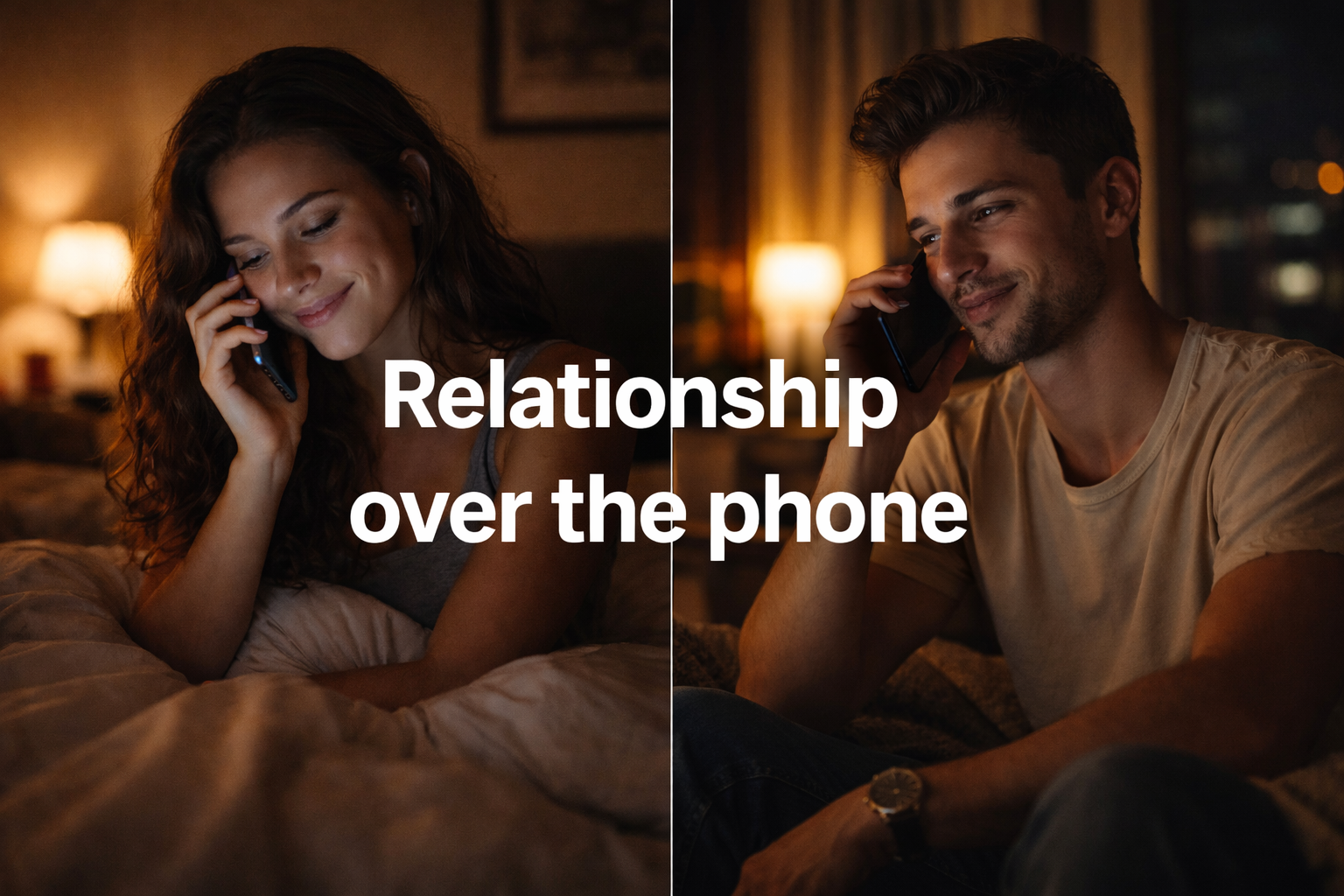
Introduction: When Love Starts Without Touch
We’ve all been taught that love begins with eye contact, chemistry, and physical presence. But what if that’s only part of the story?
In a world where connections often begin digitally, a relationship over the phone is no longer unusual—it’s becoming increasingly common. What’s surprising, however, is just how deep and meaningful these connections can become.
Some people fall in love faster through a screen than they ever did face-to-face.
But is that kind of love real? Can it last? And more importantly—should you trust it?
Let’s break it down through a real-life-inspired journey, powerful insights, and honest lessons you won’t usually hear.
The Unexpected Beginning: When a Simple Call Changes Everything
It often starts in the most ordinary way.
A mutual friend casually says, “I think you two would get along.”
A quick introduction is made, and before you even have time to think about it, a message pops up on your phone.
Sometimes it’s a spontaneous video call.
Sometimes it’s a random DM that turns into a real conversation.
Other times, it’s just a harmless late-night text that somehow stretches into hours.
At first, it feels small. Almost forgettable.
Just another conversation.
Just another number saved in your phone.
Just another person you happen to talk to.
Nothing about it seems important in the moment.
But then, something quietly begins to change.
Maybe it’s the way they made you laugh unexpectedly.
Maybe it’s how easy the conversation felt, like talking to someone you’ve known far longer than a few minutes.
Maybe it’s the comfort in their voice, the curiosity in their questions, or the strange sense of peace you feel after hanging up.
Without realizing it, your mind starts drifting back to them.
The next morning, you replay parts of the conversation.
A certain joke.
A thoughtful question they asked.
The softness in their tone when they said goodnight.
Then it happens again the next day.
And the day after that.
What once felt random begins to feel intentional.
The calls become longer.
The texts become more frequent.
Good mornings start replacing silence.
Late-night conversations become routines.
A stranger slowly becomes the person you look forward to hearing from most.
That’s the beauty of how some relationships begin over the phone.
There are no grand gestures at first.
No forced expectations.
No pressure to define anything too soon.
Just two people showing up in each other’s world through words, laughter, shared stories, and tiny moments of emotional connection.
It begins with curiosity.
A simple desire to know more.
To ask one more question.
To stay on the call a little longer.
To hear their thoughts, their dreams, their fears, and the small details they don’t tell everyone else.
And that curiosity is powerful because it allows connection to grow naturally.
Without appearances dominating the moment…
Without distractions…
Without the noise of trying too hard…
You connect with the mind first.
Then the emotions.
Then the person behind the screen.
Before long, the phone no longer feels like a device.
It becomes a bridge.
A space where vulnerability feels safer.
Where honesty comes easier.
Where feelings begin to form in the quiet spaces between midnight conversations and shared silences.
What started as “just a call” slowly becomes the start of something neither of you expected.
And sometimes, the most meaningful relationships begin exactly that way—unexpectedly, softly, and without warning.
Because the strongest connections don’t always arrive with fireworks.
Sometimes, they begin with a simple “Hello.”
From OccasioFrom Casual Texts to Daily Obsession
At the beginning, it feels light. Effortless.
A message here.
A reply there.
No pressure. No urgency. Just two people casually checking in when they can.
You don’t overthink it.
You don’t wait by your phone.
It’s simply… conversation.
But slowly, almost without warning, the rhythm begins to change.
One text turns into multiple conversations throughout the day.
“Hey” becomes “Have you eaten?”
“Goodnight” becomes “Text me when you wake up.”
What used to be occasional starts becoming consistent.
Casual chats stretch into long paragraphs.
You find yourself explaining more, sharing more, opening up in ways you didn’t plan to.
Memes turn into voice notes—because typing suddenly feels like it’s not enough to express what you really mean.
Voice notes turn into calls—because hearing their voice feels closer, more real, more… personal.
And then come the late nights.
The kind where time disappears.
Where “just 10 minutes” turns into hours.
Where silence on the line isn’t awkward—it’s comfortable.
That’s when you realize something has shifted.
This person is no longer just someone you talk to.
They’ve become part of your daily routine.
You wake up and think about texting them.
You go through your day looking for things to share with them.
Every small moment—funny, annoying, confusing—somehow feels incomplete until you tell them about it.
You start sharing everything.
Your thoughts.
Your plans.
Your random ideas at 2AM.
Even the smallest, most mundane details that no one else would care about.
And the surprising part?
They care.
They listen.
They respond.
They remember.
And that’s where it starts to feel real.
Not because you’ve met in person.
Not because anything has been defined.
But because you’re emotionally investing.
You’re showing up.
You’re letting them in.
You’re allowing them to see parts of you that aren’t always visible to the world.
And emotional intimacy like that… it does something powerful.
It creates a sense of closeness that doesn’t rely on physical presence.
It builds a connection that feels deep, even without touch.
It makes distance feel smaller than it actually is.
And slowly, that connection becomes something you crave.
Not in a dramatic, overwhelming way at first—
but in quiet, subtle moments.
Waiting for their reply starts to matter.
Hearing their voice becomes the highlight of your day.
Their absence, even for a few hours, feels noticeable.
That’s how it becomes addictive.
Not because you planned it.
Not because you forced it.
But because, somewhere along the way,
they stopped being “just someone you talk to”…
…and became someone you feel.
Why Emotional Intimacy Grows Faster Without Physical Presence
Here’s something most people don’t immediately realize:
A relationship that begins over the phone often bypasses the usual stages of dating.
There are no first impressions based on appearance.
No body language to analyze.
No external environments influencing how you interact.
It’s just… two minds meeting.
And because of that, something unusual happens.
You go deeper—faster.
In traditional dating, a lot of time is spent on surface-level interaction.
Where to go. What to wear. How to act.
There’s a subtle pressure to present the “best version” of yourself.
But over the phone?
That pressure fades.
You’re not being watched.
You’re not performing.
You’re not distracted by surroundings or trying to read physical cues.
So the conversation shifts naturally.
You don’t just talk—you open up.
You start talking about things that usually take months to come up:
Your childhood—what shaped you, what stayed with you.
Your fears—the ones you don’t easily admit out loud.
Your goals—the life you’re trying to build.
Your past relationships—what worked, what broke you.
Your insecurities—the quiet thoughts you rarely share.
There’s a kind of rawness to it.
An honesty that feels easier when there’s distance.
A vulnerability that feels safer when you’re not physically in front of someone.
It’s almost like the phone creates a protective space—
a buffer that allows you to be seen without feeling exposed.
And because of that, emotional walls come down quicker.
You’re not gradually peeling back layers…
you’re skipping straight to the parts that matter.
That’s why the connection can feel so intense, so quickly.
Because instead of building attraction first and depth later,
you build depth first.
You connect through thoughts before touch.
Through understanding before physical presence.
Through shared emotions rather than shared spaces.
And when someone understands you on that level—
when they listen, relate, and respond in ways that make you feel seen…
…it creates a powerful illusion.
It feels like you’ve known them forever.
Not because of time—
but because of depth.
Weeks of deep, consistent conversation can feel like months… even years… of knowing someone.
But there’s also something important hidden in that intensity:
When emotional intimacy grows fast, attachment can grow just as fast.
And sometimes, that connection feels stronger than it actually is in reality—
because it hasn’t yet been tested outside the world of calls, texts, and late-night conversations.
Still, in those early stages, it feels real.
Because in many ways… it is.
You’re not imagining the connection.
You’re experiencing it.
Just in a space where emotions lead—and everything else comes later.
The Power of Long Calls and Virtual Dates
There’s something deeply intimate about spending hours on the phone with someone.
Not the kind of intimacy people usually talk about—
not physical touch, not being in the same room, not grand romantic gestures.
But something quieter.
Something emotional.
It’s the kind of closeness that forms when two people choose to remain present with each other, even through a screen or a voice call.
No filters.
No pressure to impress.
No performances.
Just presence.
And presence, when it’s consistent, becomes powerful.
At first, it may seem simple.
A quick call before bed.
A spontaneous video chat during lunch.
A random check-in while running errands.
But over time, those little moments begin to stretch into something more meaningful.
You start cooking together while on video call—
laughing when one of you burns the food, comparing recipes, teasing each other about who cooks better.
What should feel ordinary suddenly feels special because you’re sharing the moment together.
Sometimes, the calls last so long that neither of you wants to hang up.
So you stay.
You talk until the conversation fades into comfortable silence.
You listen to each other breathe.
And eventually, one of you falls asleep on the phone.
It sounds small, but moments like that create an incredible sense of safety.
There’s comfort in simply knowing someone chose to stay connected until sleep found them.
Then there are the everyday routines.
You begin sharing your lives in real time.
A “come with me while I shop” video call.
A quick voice note while driving home.
A call during your evening walk.
A few minutes together while getting ready for work.
These are not dramatic romantic moments.
They’re ordinary.
But that’s exactly what makes them so intimate.
Because love and connection are rarely built in the extraordinary.
They’re built in repetition.
In consistency.
In being included in someone’s normal life.
Even the random, meaningless moments begin to matter.
Laughing uncontrollably over something that makes no sense to anyone else.
Turning an inside joke into something only the two of you understand.
Talking nonsense at 1AM because neither of you wants the night to end.
Those seemingly small interactions do something powerful:
They create emotional familiarity.
And emotional familiarity often feels just as strong as physical closeness.
Sometimes even stronger.
That’s why these moments can rival physical relationships.
Because closeness is not only about proximity.
It’s about access.
A relationship over the phone becomes a window into someone’s real life.
Not the carefully polished version someone presents on formal dates.
Not the curated image they show the world.
But the real version.
How they sound when they’re tired.
How they react when they’re stressed.
How they spend boring afternoons.
How they laugh when something genuinely catches them off guard.
You begin to witness the rhythm of their life.
And in doing so, you don’t just get to know the person they want to be.
You get to know the person they are.
That’s what makes long calls and virtual dates so powerful.
They turn distance into presence.
Ordinary moments into memories.
And a phone screen into a doorway to real connection.
The Illusion of “Perfect” Communication
At this stage, everything feels… easy.
You talk every day.
Conversations flow without effort.
You rarely run out of things to say.
There’s no awkward silence.
No forced interactions.
No confusion about whether the other person is interested.
It just works.
And because of that, it starts to feel like something rare—
like you’ve found a connection that’s naturally perfect.
But here’s the part most people don’t immediately see:
A relationship over the phone can create the illusion of perfect communication.
Not because anything is fake—
but because a lot of reality hasn’t entered the picture yet.
Think about it.
You control when and how you communicate.
If you’re not in the mood, you can reply later.
If something bothers you, you have time to process before responding.
If you don’t know what to say, you can think, edit, and respond carefully.
There’s space to manage your reactions.
And that changes everything.
In real-life interactions, communication is immediate.
Unfiltered.
Sometimes messy.
But over the phone, especially through texts and calls,
you’re often presenting the processed version of yourself.
The calm version.
The thoughtful version.
The version that has had time to choose the right words.
And while that creates smoother conversations,
it also removes friction.
Another layer?
You’re not fully experiencing each other’s real-world environments.
You don’t see how they react under daily stress.
You don’t witness their habits up close.
You’re not navigating differences in lifestyle, timing, or energy in the same physical space.
You’re interacting in a controlled setting—
one where both of you are usually choosing to show up at your best.
Even conflicts, when they happen, can feel softer.
Because distance naturally creates a pause.
A buffer.
You’re less likely to interrupt.
Less likely to react impulsively.
More likely to step back before things escalate.
And while that sounds like a good thing—it is—
it can also give the impression that you’re perfectly compatible.
But compatibility hasn’t truly been tested yet.
Because real compatibility shows up in the unplanned moments:
When one person is tired and the other wants attention.
When habits clash.
When moods don’t align.
When life gets busy, stressful, and inconvenient.
Those are the moments that shape real-world relationships.
And in a phone-based connection, many of those moments are delayed… or absent.
So what you’re experiencing isn’t fake.
The connection is real.
The conversations are real.
The feelings are real.
But the full picture?
That’s still unfolding.
It’s not perfection—
it’s partial exposure.
And that distinction matters more than most people realize.
Because when something feels perfect too early,
you may be connecting deeply with who someone is in that space…
without yet knowing who they are in every space.
When Feelings Develop Before Meeting
One of the most intense parts of a relationship over the phone is how quickly feelings can grow.
Sometimes it catches you off guard.
What started as harmless conversations, late-night calls, and shared routines slowly becomes something much deeper.
You begin to notice it in the little things.
The way your mood shifts when their name appears on your screen.
The way hearing their voice instantly calms you.
The way your first instinct after something happens is to tell them.
That’s when the emotional connection stops feeling casual.
It becomes personal.
And soon, the words start showing up.
“I’ve never connected with anyone like this.”
“I feel like you really understand me.”
“I think I’m falling for you.”
Those words can feel incredibly powerful—because in that moment, they often reflect something real.
And sometimes, it is genuine.
The comfort is real.
The vulnerability is real.
The consistency is real.
The emotional bond is real.
When someone has become part of your thoughts, your routine, and your inner world, feelings naturally begin to form.
That part is human.
But this is also where something important happens:
Emotional acceleration.
This is when feelings begin developing faster than reality can actually support.
Because while the emotional intimacy may be deep, the relationship itself still exists in a limited environment.
You know how they sound.
You know how they think.
You know how they communicate.
But there are still important unknowns.
You haven’t seen how they move through real-life stress beside you.
You haven’t experienced how your energies match in the same space.
You don’t yet know whether the chemistry you feel emotionally translates physically.
And those unknowns matter.
Because feelings often grow in the space of what is known and what is imagined.
The mind naturally fills in the blanks.
You begin to build a picture of them—
their mannerisms, their presence, how it might feel to finally sit beside them.
Sometimes that picture is accurate.
Sometimes it’s idealized.
That’s why this stage requires a delicate balance.
Trust your emotions.
Don’t dismiss what you genuinely feel just because it happened through a phone.
A real connection can absolutely begin that way.
But at the same time, don’t ignore the unknowns.
Feelings are valid.
They’re important.
But they are not always complete evidence of long-term compatibility.
Until you meet, there is still a gap between perception and reality.
A gap between who someone feels like in your mind…
and who they are in real life.
That doesn’t make the connection less meaningful.
It simply means the story is still unfinished.
The emotions may already be strong,
but reality still has a role to play.
And sometimes, meeting confirms everything you felt.
Other times, it reveals the parts the phone could never show.
That’s why this stage is so intense.
You’re standing between what you feel…
and what is still waiting to be proven.
The First Meeting: Reality Meets Expectation
When you finally meet, everything changes.
For so long, the relationship has lived in voices, messages, screens, and imagination.
Now, suddenly, it’s real.
No more waiting for the call.
No more staring at a typing bubble.
No more imagining what their presence feels like.
They’re right there.
And with that moment comes a rush of emotions all at once:
Excitement.
Nervousness.
Curiosity.
Anticipation.
Your heart races in a way texts never prepared you for.
Because beneath all the excitement sits one question that neither of you can fully answer until the moment happens:
“Will this feel the same in person?”
That question carries so much weight because this meeting is more than just a date.
It’s a test of alignment.
A moment where emotional intimacy meets physical reality.
For many couples, this is where everything clicks.
The conversation flows just as easily in person.
The laughter feels even warmer.
The silences feel even safer.
The chemistry that existed through the phone suddenly gains a physical dimension.
Sometimes, it’s even better than expected.
Because the emotional foundation was already there.
You’re not meeting a stranger.
You’re meeting someone whose mind, fears, routines, and dreams you already know.
That familiarity can make the physical connection feel deeper, softer, and surprisingly natural.
A hug feels more meaningful.
Eye contact feels more intense.
Even simple moments—walking side by side, sitting across from each other, sharing food—carry emotional weight.
It’s as if everything you built through words finally has a body, a presence, and a space to exist in.
But for others, the experience feels… different.
Not necessarily bad.
Not wrong.
Just different.
And that difference can be confusing.
Because the version of someone you know through the phone is built partly from reality and partly from imagination.
You know their voice.
Their thoughts.
Their emotional patterns.
But your mind has also been filling in the blanks.
How they carry themselves.
How they move through a room.
How their energy feels beside yours.
How the chemistry translates without a screen.
A relationship over the phone naturally builds a version of someone in your mind.
Not a false version—just an incomplete one.
And when real life enters, the missing pieces suddenly appear.
Sometimes they fit perfectly.
Sometimes they challenge the image you unconsciously created.
Maybe they’re quieter in person than you expected.
Maybe their humor lands differently face-to-face.
Maybe the emotional chemistry is strong, but the physical rhythm feels unfamiliar.
That’s why the first meeting can feel so emotionally intense.
It’s the moment expectation meets reality.
And reality, even when beautiful, is rarely identical to imagination.
But that doesn’t mean the connection was fake.
It simply means the relationship is moving into its most honest stage.
The stage where what you felt now has to coexist with what is real.
And that’s where true compatibility begins.
Not in perfect calls.
Not in late-night fantasies.
But in the moment two real people stand in the same space and discover whether the connection can live beyond the phone.
Distance removes convenience, so effort becomes the clearest proof of intention.
When two people are physically apart, love can no longer rely on the easy things: random meetups, casual touch, seeing each other after work, or spending time together simply because you’re in the same place. In long-distance love, everything meaningful has to be chosen on purpose.
That’s why effort matters more than distance.
1) Effort turns love into action
Anyone can say they care.
But distance forces people to demonstrate it through behavior.
It shows in the person who:
- checks in consistently, not only when it’s convenient
- makes time even after a stressful day
- remembers the small details you mentioned
- stays emotionally present during difficult moments
- makes plans for the future instead of keeping things vague
These actions communicate something powerful:
“You matter enough for me to be intentional.”
And intentionality is what keeps long-distance love alive.
2) Consistency builds emotional safety
In a phone-based or long-distance relationship, communication is the relationship’s lifeline.
So consistency becomes more than just texting often—it becomes emotional reassurance.
When someone regularly calls, replies thoughtfully, and creates moments to stay connected, they help reduce the natural anxiety distance can create.
That consistency says:
- I’m still here
- I still choose this
- You are still important to me
Without that effort, distance quickly starts to feel like emotional absence.
3) Busy schedules expose true priorities
Everyone gets busy.
Work, family, stress, and life responsibilities can make any relationship harder.
But effort is revealed in who still finds a way.
It may not always be long conversations. Sometimes it’s a short voice note, a “thinking of you” text, or staying up a little later just to hear your voice.
The point is not perfection.
The point is priority.
People make time for what genuinely matters to them.
So when someone consistently creates space for you despite pressure, it reflects real intention.
4) Planning visits is emotional investment
One of the strongest forms of effort in long-distance love is planning to meet.
Visits require:
- money
- scheduling
- sacrifice
- anticipation
- commitment
So when someone actively works toward seeing you, they’re doing more than planning a trip.
They’re building shared reality, not just shared conversations.
It shows they want the relationship to exist beyond screens and phone calls.
That level of effort gives the relationship direction and hope.
5) Emotional availability matters even more than texting
Some people communicate often but remain emotionally distant.
Real effort is not just frequent contact—it’s meaningful presence.
It’s being open, vulnerable, honest, and willing to hold difficult conversations.
Distance can amplify insecurities, misunderstandings, and loneliness.
So when someone shows emotional maturity and stays available through those moments, it proves they’re not just maintaining contact—they’re protecting the connection.
The deeper truth
Distance itself is rarely what breaks a relationship.
Lack of effort does.
Because when someone truly values the bond, they find ways to close the emotional gap even when the physical gap remains.
So yes, if someone continues to show up, stay consistent, plan ahead, and invest emotionally despite the miles between you, that is never accidental.
It is a reflection of choice.
And in long-distance love, choice is one of the purest forms of love there is.
The “Golden Rule” Most People Learn Too Late
There’s a lesson many people only understand after they’ve been hurt, drained, or taken for granted:
Don’t over-invest before you see real effort.
At the beginning, everything feels exciting. You’re willing to do more—text first, call more, plan visits, even spend money just to keep the connection alive. It feels like love, but sometimes… it’s just one-sided effort in disguise.
This shows up clearly in long-distance or “over-the-phone” relationships.
One person is always:
- Booking flights
- Rearranging their schedule
- Sacrificing time, money, and energy
- Trying to “make it work” no matter what
While the other person?
They’re just… there. Responding. Going along. Doing the bare minimum.
And because you care, you convince yourself:
“Maybe they’re just busy.”
“Maybe they’ll do more later.”
“Maybe if I love them harder, they’ll match me.”
But here’s the truth most people learn too late:
Effort is not something you beg for. It’s something you observe.
A healthy relationship—even from a distance—should feel mutual. Not perfectly equal every single day, but balanced over time.
Both people should:
- Make plans
- Initiate conversations
- Show up consistently
- Invest emotionally and practically
Because when effort is one-sided, something dangerous starts to build quietly…
Resentment.
You won’t notice it at first.
But over time, it turns into:
- Frustration (“Why am I always the one trying?”)
- Doubt (“Do they even care like I do?”)
- Exhaustion (“I’m tired of carrying this alone.”)
And eventually, love starts to feel like a burden instead of a connection.
That’s why the real golden rule is this:
Match effort. Don’t chase potential.
If someone is genuinely interested in you, you won’t have to overextend yourself just to feel valued. They’ll meet you halfway—sometimes even come further.
Because real love doesn’t feel like you’re constantly proving your worth.
It feels like you’re both choosing each other—again and again—without force.
When Reality Starts to Set In
At the beginning, everything feels effortless.
You’re excited to talk.
You stay up late on calls.
Every notification from them makes your heart jump.
Distance doesn’t even feel like a problem—because the emotions are strong enough to cover it.
But then… reality slowly starts to settle in.
The conversations become less about excitement and more about everyday life.
Less flirting, more figuring things out.
Less fantasy, more real situations.
And that’s when the real challenges begin to show up:
- Different lifestyles – One of you is always busy, the other has more free time
- Work schedules – Calls become harder to coordinate
- Financial pressure – Traveling, gifts, and time off aren’t always easy
- Communication styles – One wants constant updates, the other prefers space
These aren’t small things—they’re the kind of differences that test compatibility, not just feelings.
Because the truth is…
It’s easy to connect when everything feels exciting.
When it’s all late-night talks, sweet words, and imagined futures.
But real love?
Real connection?
That shows up when things get inconvenient.
When:
- You’re both tired but still choose to communicate
- There’s a misunderstanding, but you both try to fix it
- Life gets stressful, but you don’t disappear on each other
This is where many “over-the-phone” relationships either grow stronger… or quietly fall apart.
Because without physical presence, communication becomes everything.
And when communication weakens, the distance feels even bigger.
You start noticing things you ignored before:
- Delayed replies feel heavier
- Effort becomes inconsistent
- Small issues turn into bigger doubts
And that’s when the real question appears:
Are we actually building something real… or just holding onto a feeling we had at the start?
Because excitement can start a relationship—
but only effort, consistency, and emotional maturity can sustain it.
The Hidden Challenge: Conflict Without Physical Presence
One of the most overlooked struggles in a relationship over the phone is not love…
It’s how conflict is handled.
Because when everything is going well, distance feels manageable.
But the moment tension enters the picture, the gap between you suddenly feels much wider.
In person, conflict has soft edges.
A simple hug can calm things down.
Eye contact can reassure you.
Even silence can feel comforting instead of threatening.
But over the phone?
Everything becomes sharper. Harder. Easier to misunderstand.
- A short reply feels like attitude
- A delayed message feels intentional
- A missed call feels like avoidance
- Tone gets guessed… and often guessed wrong
And the truth is, you’re not just hearing words—you’re interpreting them without context.
No facial expressions.
No body language.
No physical reassurance.
So your mind fills in the gaps… and not always in a healthy way.
That’s how small issues quietly grow into big problems.
A simple misunderstanding turns into:
- “Why are you acting like this?”
- “You’ve changed.”
- “Maybe I care more than you do.”
And before you know it, you’re no longer solving the issue—
you’re reacting to how it felt instead of what actually happened.
Silence becomes louder than words.
When someone goes quiet in person, you can still feel their presence.
But over the phone, silence can feel like distance… rejection… even punishment.
That’s why communication style matters more than ever in long-distance or phone-based relationships.
Because if one person:
- Needs reassurance
- Wants to talk things out immediately
And the other:
- Shuts down under pressure
- Needs space before responding
You don’t just have a disagreement…
You have a communication mismatch.
And that mismatch, if not understood, can slowly break the connection.
The truth most people don’t realize:
In long-distance or phone-based relationships,
you don’t just need love—you need emotional discipline.
The ability to:
- Clarify instead of assume
- Be patient instead of reactive
- Communicate clearly instead of emotionally shutting down
Because without that, distance doesn’t just separate you physically…
It starts separating you emotionally too.
When Communication Styles Clash
Not everyone handles conflict the same way.
Some people want to fix things immediately.
They want to talk, understand, and resolve it right now.
Others?
They need space. Time to process. Time to cool off before saying something they might regret.
Neither is wrong.
But in a relationship over the phone…
These differences don’t just exist—they get amplified.
Because there’s no physical presence to soften the tension.
No hug. No reassurance. No “we’re okay” feeling in the moment.
So what happens?
One person is pushing for a conversation:
“Can we talk about this now?”
“I don’t like how this feels.”
While the other is pulling away:
“I just need some time.”
“I don’t want to argue.”
And suddenly, it’s not just about the issue anymore…
It becomes a cycle.
- The more one person pushes → the more the other withdraws
- The more the other withdraws → the more anxious the first person becomes
And just like that, both people feel misunderstood.
One feels ignored.
The other feels overwhelmed.
This is where frustration quietly builds.
Because from your perspective, you’re just trying to fix things.
From theirs, it feels like pressure.
From their perspective, they’re trying to avoid making things worse.
From yours, it feels like they don’t care enough to try.
Same situation. Completely different interpretations.
And over time, this gap becomes exhausting.
Conversations start to feel like battles instead of solutions.
Small disagreements carry emotional weight from past unresolved issues.
Patience runs thin.
Until one day, it’s not even about communication styles anymore…
It’s about emotional distance.
The truth most people miss:
Compatibility isn’t just about love, attraction, or shared interests.
It’s about how you handle difficult moments together.
Because if two people can’t find a middle ground—
where one learns to give reassurance,
and the other learns to communicate without pressure—
Then even strong feelings won’t be enough to hold things together.
A relationship over the phone doesn’t just test your connection…
it tests your ability to understand each other under pressure.
And if that understanding isn’t built intentionally,
the gap doesn’t just stay… it grows.
The Slow Fade: How Distance Can Amplify Disconnection
Most relationships don’t end with a big fight.
They don’t always close with clear words or a final goodbye.
They fade.
Slowly. Quietly. Almost unnoticeably at first.
Calls that used to last hours… become minutes.
Good morning texts turn into occasional check-ins.
Replies that were instant… start taking hours… then days.
And the hardest part?
No one announces the change.
It just… happens.
In a relationship over the phone, this shift cuts deeper.
Because communication isn’t just part of the relationship—
It is the relationship.
There’s no physical presence to fall back on.
No casual time together.
No silent moments that still feel connected.
So when communication starts fading…
There’s nothing left to hold onto.
At first, you try to ignore it.
You tell yourself:
- “They’re just busy.”
- “Maybe they’re stressed.”
- “It’s just a phase.”
So you compensate.
You text more.
You try to keep conversations alive.
You put in extra effort to bring back what you felt before.
But deep down…
You feel the shift.
The energy isn’t the same.
The excitement isn’t mutual anymore.
The effort feels… uneven.
And this is where it becomes painful.
Because you’re not grieving something that ended…
You’re grieving something that’s slowly disappearing.
No closure.
No clear reason.
Just a growing distance that you can feel—but can’t fully explain.
Over time, the silence gets louder.
Conversations feel forced.
Replies feel like obligations.
And the connection that once felt natural…
Starts to feel like work.
The truth is:
Disconnection rarely happens overnight.
It’s built through:
- Unanswered messages
- Missed opportunities to connect
- Emotional withdrawal
- Unspoken feelings
Small moments… that slowly create a big distance.
And in phone-based relationships, once communication weakens,
Everything weakens.
Because without consistent effort, clarity, and intention…
Distance doesn’t just stay physical.
It becomes emotional.
The hardest lesson?
Sometimes people don’t leave all at once.
They leave in pieces.
And by the time you fully realize it…
They’re already gone.
The Breakup: When Connection Isn’t Enough
Sometimes, the hardest truth to accept is this:
Love alone isn’t enough to sustain a relationship.
You can care deeply about someone.
Miss them constantly.
Feel emotionally connected in a way that feels rare and real.
And still… it doesn’t work.
Because beyond the feelings, there are realities that love can’t ignore:
- Compatibility – Do your personalities actually fit long-term?
- Communication – Can you understand each other when things get hard?
- Shared values – Do you believe in the same things that shape a future?
- Life direction – Are you even heading toward the same kind of life?
These aren’t small details.
They’re the foundation.
In a relationship over the phone, it’s easy to build a strong emotional bond.
You talk for hours.
You share your thoughts, your fears, your dreams.
You feel seen and understood.
And because of that…
The connection can feel deeper than most in-person relationships.
But here’s the part people don’t always realize:
Emotional connection can sometimes hide incompatibility.
Because when you’re not living life side by side,
you don’t fully experience each other’s habits, routines, or real-world differences.
So everything feels aligned… until reality steps in.
And when it does, the cracks begin to show:
- You handle stress differently
- You want different things long-term
- You struggle to resolve conflict
- You realize your lifestyles don’t truly match
And suddenly, you’re faced with a painful question:
“How can something that feels so right… still not work?”
That’s where many relationships reach their limit.
Not because the love wasn’t real.
But because the foundation wasn’t strong enough to carry it forward.
This is the part that hurts the most:
Walking away from someone you still care about.
Not because you stopped loving them—
but because you finally understood that love, by itself, couldn’t fix what was missing.
The truth most people learn too late:
A relationship doesn’t survive on connection alone.
It survives on:
- Alignment
- Effort
- Growth
- Understanding
Because without those, even the strongest emotional bond…
Eventually breaks under pressure.
And sometimes, letting go isn’t failure.
It’s choosing reality over attachment.
The Aftermath: Missing the Connection, Not Just the Person
After it ends, there’s a kind of silence you’re not prepared for.
Not just the absence of them…
But the absence of what you built together.
Because what hurts isn’t always just the person.
It’s the connection.
You don’t just miss them.
You miss:
- The constant communication
- The emotional check-ins
- The “good morning” and “goodnight” messages
- The feeling that someone, somewhere, was always there for you
It becomes part of your routine.
Part of your day.
Part of your life.
And in a relationship over the phone, that connection runs even deeper.
Because communication wasn’t just something you did—
It was everything.
There were no random hangouts.
No physical presence.
No shared spaces.
Just words.
Calls.
Messages.
And somehow… that was enough.
Until it wasn’t.
So when it ends, the loss feels different.
It’s not just heartbreak.
It’s withdrawal.
You reach for your phone out of habit… then remember there’s no one to text.
You want to share something small… but there’s no “person” for it anymore.
You notice how quiet your day has become.
And that silence?
It hits harder than expected.
Because you’re not just grieving a person.
You’re grieving a pattern.
A rhythm you got used to:
- Talking every day
- Feeling emotionally supported
- Having someone consistently in your space—even from a distance
And when that disappears, it leaves a gap that’s hard to explain to anyone else.
This is the part most people don’t talk about:
Sometimes you don’t even want them back.
You just want:
- The feeling
- The comfort
- The consistency
The connection.
And that’s what makes healing complicated.
Because you have to separate the two:
- The person who couldn’t stay
- And the connection you still crave
The truth is:
Just because you miss the connection…
Doesn’t mean the relationship was right for you.
It just means you’re human.
You felt something real.
You built something meaningful.
And now you’re learning how to exist without it.
But slowly, over time…
You create new routines.
You find new sources of connection.
You rebuild your emotional space.
And one day, the silence won’t feel empty anymore.
It’ll feel peaceful.
Can These Relationships Ever Work Long-Term?
The honest answer?
Yes… but not by accident.
A relationship over the phone can work long-term—but only when both people are intentional, aligned, and willing to do more than just “feel” the connection.
Because love might start it…
But structure is what sustains it.
1. Strong Communication Isn’t Optional—It’s Everything
In a phone-based relationship, communication replaces physical presence.
So it has to be:
- Clear
- Consistent
- Honest
Not just talking every day, but understanding each other.
Because when communication breaks down, there’s nothing else to fall back on.
2. Emotional Maturity Keeps It Stable
There will be:
- Misunderstandings
- Delayed replies
- Moments of doubt
Without emotional maturity, these turn into arguments, assumptions, and unnecessary distance.
But with it?
You learn to:
- Clarify instead of accuse
- Stay calm instead of reacting
- Work through issues instead of avoiding them
3. Mutual Effort Is Non-Negotiable
One person can’t carry the relationship.
It won’t last.
Both people have to:
- Initiate conversations
- Make time for each other
- Show consistency
- Invest emotionally and practically
Because effort is the only thing that keeps the connection alive across distance.
4. There Must Be a Clear Direction
This is where many long-distance or phone-based relationships fail.
No plan.
No timeline.
No clarity on when or how you’ll eventually be together.
And without that?
The relationship starts to feel like it’s stuck in place.
Love needs a direction to grow.
Even if the plan isn’t perfect, there has to be a shared vision:
- Visits planned
- A future discussed
- A goal to close the distance
The Reality Most People Avoid:
Without these four things, the relationship doesn’t usually end dramatically…
It slowly wears down.
Effort fades.
Communication weakens.
Doubt increases.
Until one or both people quietly let go.
But when it does work?
It’s because two people made a conscious decision:
Not just to love each other…
But to build something real despite the distance.
Final Truth:
A relationship over the phone can survive long-term—
But only if both people treat it like something real, not something temporary.
Two Truths Most People Ignore About Phone-Based Love
1. Distance Isn’t the Real Problem
People often blame distance when things fall apart.
But in reality, distance exposes problems—it doesn’t create them.
If communication is weak, distance amplifies it.
If compatibility is off, distance reveals it faster.
2. Emotional Connection Alone Isn’t Enough
You can feel deeply connected to someone and still not be right for each other.
A relationship over the phone can create intense emotional bonds—but real-life compatibility still matters.
And that’s where many relationships fail.
The Unexpected Benefit: Learning What You Truly Need
Even if it doesn’t last, a relationship over the phone teaches you a lot.
You learn:
- What you value in communication
- How you handle emotional intimacy
- What you need from a partner
And those lessons stay with you.
Final Thoughts: Should You Give It a Chance?
If you’re wondering whether to pursue a relationship over the phone, here’s the honest answer:
Yes—but stay aware.
Don’t ignore red flags. Don’t rush emotions. And don’t assume that connection equals compatibility.
At the same time, don’t dismiss it either.
Because real love doesn’t always start the way we expect.
Sometimes, it begins with a message.
A call.
A conversation that feels different from all the rest.
And sometimes… that’s all it takes.
Bonus Insight #1: How to Make a Relationship Over the Phone Stronger
- Set communication expectations early
- Mix texting with voice and video calls
- Be honest about your feelings
- Plan real-life meetings
- Maintain your independence
Bonus Insight #2: Signs Your Phone Relationship Is Actually Worth It
- You feel emotionally safe
- Communication is consistent
- Effort is mutual
- Conflicts get resolved—not avoided
- There’s a clear future plan
